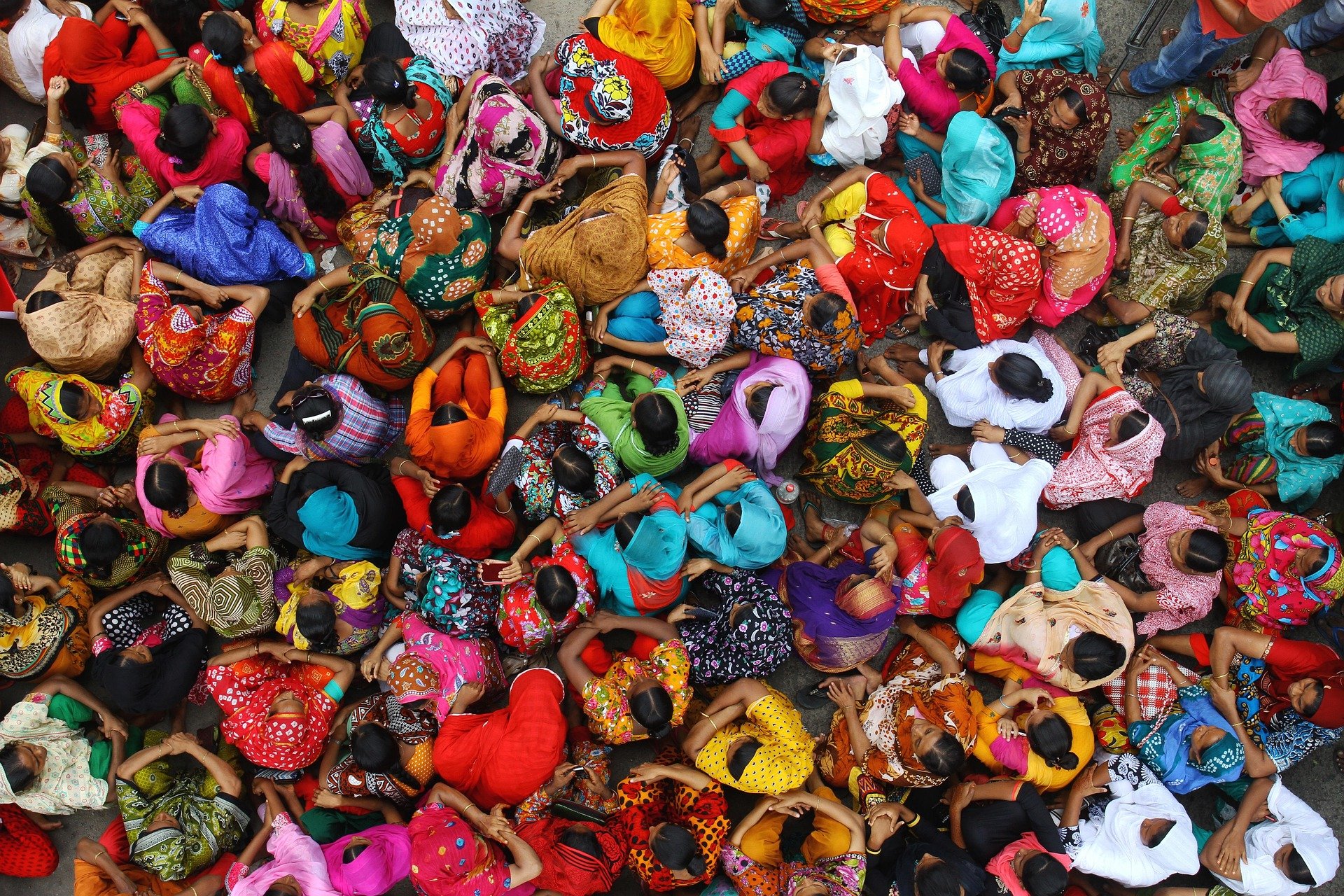



Cover photo: A crowd of protesting Indian women. Licensed via Pixabay.
“Just this June, an 11-year-old Indigenous girl from the community was brutally raped.”
The words come from Ushing, a 26-year-old Indigenous activist from Bandarban, a district in Bangladesh’s Chittagong Hill Tracts near the Myanmar border.
The child’s family had already been displaced after their ancestral land was claimed through formal state processes. Without formal land titles—since land in the hills is traditionally held collectively—they moved to a more isolated area. That is where the assault occurred.
“It’s not a mere sexual thing now,” Ushing says. “It’s a tool. It’s a weapon.”
According to her, there is a direct connection between land and gendered violence. When land is grabbed, communities fragment—and with that fragmentation, women and girls lose the informal protection networks that once surrounded them. Displacement increases vulnerability to gender-based violence, and fear becomes a method of control.
Ushing belongs to the Marma Indigenous community, one of the Jumma peoples of Bangladesh’s Chittagong Hill Tracts—a mountainous region in the country’s southeast bordering India and Myanmar. The area remains heavily militarized decades after the 1997 peace accord ended a decades-long insurgency. Military camps still dot the hills. Demographic shifts have altered the ethnic balance. Indigenous identity itself remains politically sensitive—often framed as a security issue rather than a political one.

At the age of 19, Ushing joined protests without fully understanding the legal terminology surrounding land commissions and administrative reform. Today, she leads Green Milieu, a youth-led initiative she co-founded in 2021 to train Indigenous students—particularly girls from remote villages—on environmental awareness, Indigenous knowledge, and leadership.
During our interview, Ushing carries a handwoven bag patterned in traditional Marma designs—not as ornament, but as identity. Women in the hills produce and sell such textiles, sustaining small circular economies. The bag has helped finance her travel to international forums where she speaks about her community and Indigenous land rights.
Yet the traditions woven into such textiles are inseparable from the land itself. In the Chittagong Hill Tracts, land disputes are often framed as bureaucratic disagreements over property. Ushing sees something else: land loss as a slow reshaping of who belongs—and who does not. For Indigenous women, she argues, the consequences are written not only on land records, but on their bodies.
Ushing’s story reflects a broader regional pattern. Across Southeast Asia, Indigenous territories are increasingly targeted by expanding extractive economies and shrinking civic space—and land dispossession rarely affects men and women equally. When forests are cleared and communities are displaced, women’s labor intensifies, girls’ education is disrupted, and sexual violence becomes a tool of intimidation and control. In this landscape, a new generation of Indigenous women is emerging not only as activists, but as political actors defending land, culture, and community survival.
Defending land across the region has also become increasingly dangerous. Monitoring by Global Witness shows that the region remains one of the most perilous for environmental and land defenders opposing mining, logging, dams, and agribusiness expansion. In 2024 alone, globally, at least 146 land and environmental defenders were killed or disappeared, approximately one-third of them are Indigenous or Afro-descendant.

Indigenous communities are disproportionately targeted because their territories often overlap with mineral reserves, biodiverse forests, and commercially valuable agricultural land. Beyond killings, defenders frequently face legal harassment, militarization, red-tagging, and prolonged land recognition processes that leave communities in limbo.
Nitya Rao, professor of Gender and Development at the University of East Anglia’s School of Global Development, describes the pattern bluntly: “There’s a real assault on these territories and these resources.”
Over the past three decades, she argues, globalization and the race for economic growth have intensified pressure on so-called “untouched” regions. “As the world got globalized… I think that really increased the onslaught on all these untouched areas in terms of the resource.”
For Rao, the issue is not only environmental but structural. Development frameworks continue to measure national success through GDP and infrastructure expansion, often overlooking the social cost of land dispossession.
The Gendered Architecture of Dispossession
What rarely appears in official reporting on land disputes is how profoundly these conflicts reshape gender relations within Indigenous communities.
Professor Rao cautions against romantic simplifications. “I don’t really believe that women are necessarily closer to nature,” she explains.
Instead, she points to a deeply gendered division of labor. In many Indigenous societies across Asia, women are primarily responsible for water collection, gathering fuelwood, cultivating subsistence crops, and sourcing forest foods. These responsibilities fall under what economists classify as reproductive labor—essential for household survival yet largely invisible in economic metrics.
“Because these are seen as part of women’s reproductive work… when these forests get destroyed or the water tables go down… their job gets harder and harder.”
Environmental degradation, in this sense, produces what Rao describes as time poverty. The 2023 UN Women regional assessment on climate vulnerability in Asia confirms that environmental stress significantly increases unpaid care and domestic labor for rural women, limits income diversification, and heightens exposure to gender-based violence in displacement settings. As forests shrink or access to land is restricted, women walk farther, work longer, and carry heavier burdens.
The consequences ripple through community life: girls drop out of school, women lose time for income-generating work, and participation in decision-making declines. Land dispossession does not simply displace communities—it deepens existing gender inequalities.
In Mindanao, the southernmost major island of the Philippines, these structural dynamics take concrete form.
Rica, a 26-year-old Teduray-Lambangian Indigenous advocate in the Bangsamoro region of the southern Philippines, works at the intersection of tribal governance and civil society, pushing for ancestral domain recognition under the Indigenous Peoples’ Rights Act (IPRA). Born during armed conflict and raised amid repeated displacement, she has watched how extractive projects and corporate expansion alter social dynamics on the ground.
“When companies come,” she says, referring to mining and plantation operations in Mindanao, “the workers are from other regions. They don’t know our context. They won’t stay long. So they feel they can do anything.”
Her point is structural rather than individual. Transient labor forces, weak accountability mechanisms, and unresolved land tenure create conditions in which abuse can occur with impunity.
Local monitoring groups have reported increases in gender-based violence in areas affected by corporate expansion and militarized security. But even when violence occurs, justice remains fraught.
“In some communities,” Rica explains, “cases are settled quietly. They say it is to protect the dignity of the victim.”
In practice, that can mean financial compensation negotiated between families — or, in some cases, forcing a girl to marry her perpetrator if they are of similar age. The result is what Rica calls “another layer” of violence: one imposed not only by outside actors, but reinforced by patriarchal norms within the community itself.
For young Indigenous women like her, the struggle is double-sided.
“The challenge for the youth,” she says, “is both from outside and from inside the community.”
Externally, they confront corporate actors, state bureaucracy, and land policies that sideline customary tenure. Internally, they navigate traditional leadership systems where decision-making remains male-dominated, and youth voices are often dismissed. Indigenous women may hold symbolic representation in regional structures, but meaningful power — budget control, voting authority, enforcement — remains limited.
Professor Rao’s research supports this pattern. Extractive development, she argues, does not create gender inequality — it deepens existing hierarchies. As land becomes commodified, customary governance systems are increasingly pressured to adapt to legal state frameworks that have historically recognized male landholders.
Militarization and the Normalization of Fear
In many Indigenous regions across South and Southeast Asia, extraction is rarely presented as extraction alone. It is framed as development, secured through military presence, and administered through state authority.
The result is a layered landscape: mining corridors guarded by armed forces, plantation zones patrolled in the name of stability, and ancestral territories mapped simultaneously as security risks and economic assets.
In Mindanao, the southernmost major island of the Philippines, Rica grew up within that convergence.
“I was born during the war’s fallout,” she says.
Her childhood unfolded during protracted armed conflict between state forces and Moro liberation groups. Gunfire was not a distant echo; it was a signal.
“When we heard gunshots, we already knew we had to move. It looked normal for us.”
The Bangsamoro Autonomous Region, established after the 2019 peace agreement between the Philippine government and the Moro Islamic Liberation Front, was meant to mark a political transition. Yet the presence of armed actors did not vanish overnight. In heavily securitized areas of the Philippines, human rights organizations have documented patterns of surveillance and “red-tagging” — publicly labeling activists as insurgent sympathizers. The UN Special Rapporteur on freedom of expression has described this practice as a serious threat to civil society, exposing activists to harassment, arbitrary detention, and violence. In such environments, advocacy becomes a calculation.
Similar dynamics have unfolded in Manipur, a conflict-affected state in India’s northeast bordering Myanmar. Indigenous scholar and peace activist Dr. Bina Lakshmi Nepram has spent decades documenting the effects of conflict under extraordinary security laws. Nepram is the founder of the Manipur Women Gun Survivors Network, which supports widows and survivors of gun violence, and the Global Alliance of Indigenous Peoples, an international network advocating for Indigenous rights and peacebuilding.
“There’s a war happening on Indigenous women’s bodies, lands and territories,” she says.
For much of the past half-century, Manipur has been governed under India’s Armed Forces (Special Powers) Act (AFSPA), a law widely criticized for entrenching militarization and weakening civilian oversight. Since 2023, renewed ethnic violence—marked by killings and mass displacement—has escalated sharply, reinforcing how instability in the region continues to intensify.
“When you grow up in such a situation, you will think it was normal.”
Across these regions, militarization shapes everyday life. Movement is controlled. Speech becomes cautious. For Indigenous communities, these pressures shape daily life as much as political conflict. Women often bear the heaviest burden. Displacement fractures kinship networks, checkpoints restrict access to forests, rivers, and fields, and reporting abuse becomes difficult where corporate and state actors wield overlapping power.
Young Indigenous women organize within this constrained environment. They navigate legal systems while calculating personal risk. They build alliances under surveillance and speak strategically in places where silence has long been enforced. When land becomes securitized, culture becomes collateral. For the young women leading today’s movements, defending territory also means defending the right to inherit culture, memory, and political voice.
Land as Memory, Language as Continuity
For many Indigenous communities across Southeast Asia, land is not scenery. It is a living system that shapes identity, belonging, and survival.
For Ushing, that relationship is direct and personal.
“The forest has its own system,” she says. “Only the people who live with it understand it — and we are part of it.”
Her words reflect a worldview rooted in interdependence. Ecological rhythms organize social life. Agricultural cycles structure time. Knowledge of land moves through stories, songs, and daily practice. When territory shifts, the rupture is cultural as much as material.
These dynamics extend far beyond Bangladesh. Political anthropologist Dr. Manuela Picq, whose research examines Indigenous governance across regions, argues that what is often labeled “ritual” can function as political infrastructure. Cultural practices tied to seasons and land, she says, “have a lot to do with governance and weaving community relations non-stop.”
Across continents—from Latin America to Southeast Asia—land-based traditions regulate belonging, preserve collective memory, and sustain systems of authority that often operate beyond formal state institutions.
Women frequently anchor that continuity. Picq observes that they “sustain the language… they transfer the language to the children and pass on knowledge of the land.” Preservation unfolds in everyday life—in the words spoken at home, in planting practices, and in stories that define belonging.
Indigenous linguistic heritage, however, remains vulnerable. UNESCO estimates that nearly 40 percent of the world’s roughly 7,000 languages are endangered, with Indigenous languages disproportionately at risk.
As Professor Rao notes, many Indigenous languages remain primarily oral, while younger generations are educated in dominant national systems. “There is no written form,” Rica says, expressing concern that without documentation cultural heritage could erode as globalization accelerates.

In Mindanao, Rica describes similar efforts: ancestral languages maintained at home, traditional garments worn in public spaces, knowledge transmitted across generations even as young women enter universities and state institutions.
Across these regions, land, language, and identity remain inseparable. But preservation alone is no longer sufficient. For this generation, education, political literacy, and digital platforms are becoming the next terrain of resistance.
Education as Resistance
Education has become a strategic tool for Gen Z Indigenous women. Across Southeast Asia, young activists are using legal literacy, land documentation, and media engagement to translate ancestral knowledge into the language of law and challenge development narratives that erase Indigenous presence. This comes at a moment when more than half of Southeast Asia’s population is under the age of 30, with roughly one-third aged between 15 and 34—a demographic shift reshaping civic and political life across the region.
In the Chittagong Hill Tracts of southeastern Bangladesh, Marma’s youth initiative brings together students aged 16 to 26 to learn robotics and STEM skills, practice public speaking, and discuss leadership and emotional intelligence. Beneath the curriculum lies a political objective: fluenc—the ability to move between oral memory and institutional vocabulary, and between village realities and international forums.
Digital platforms extend that strategy. Social media has become a connective infrastructure, allowing activists in Bangladesh, Mindanao, and other Indigenous territories to exchange strategies, amplify local cases, and build cross-border solidarity. Environmental violations can be documented in real time, while youth leaders collaborate with feminist and environmental networks and situate local struggles within broader debates on climate justice and Indigenous sovereignty.
But amplification is double-edged. The CIVICUS Monitor currently classifies several Southeast Asian countries, including Bangladesh and the Philippines, as “repressed” or “obstructed” civic spaces—reflecting documented restrictions on activism and dissent.
In militarized regions like the one Rica grew up in, speaking publicly requires calculation. Activists often limit what they share, avoid certain language, or withhold identifying details, aware that online visibility can invite harassment, surveillance, or political labeling. As Nepram warns, in conflict-affected areas struggles over land are often intertwined with attempts to control women’s bodies and silence their voices.
Many stories therefore remain untold, confined to private conversations shaped by fear or strategy. Education, then, becomes more than knowledge: it is a way of navigating power—knowing when to speak, how to frame a claim, and where to build alliances. In doing so, it links gender justice, cultural survival, and land defense into a political language that can travel beyond militarized borders.
As young Indigenous women connect local struggles to global conversations, they are not only defending territory but expanding the debate itself. The future of these communities may depend less on policy promises than on whether their voices—cautious, strategic, and often constrained—can continue to reach beyond the boundaries imposed on them.
Shared Struggles Across Borders
If the pressures facing Indigenous communities are engineered and structural, so too are the responses now taking shape.
From the hills of Bangladesh to the plains of Mindanao and the valleys of Manipur, young Indigenous women are confronting familiar patterns: militarized territories, extractive expansion, shrinking civic space, and persistent gender inequality. Political systems differ, but the architecture of dispossession — and resistance — looks strikingly similar.
For Nepram, that recognition extends beyond the region. “Wars are engineered,” she says. “If you can manufacture wars, if you can engineer wars, we can also engineer peace.”
Her warning is direct: “Greed for power and money is taking us to doom.”
The response, she argues, cannot rely on individual bravery alone. It requires coordination, memory, and long-term strategy.
Professor Rao observes a parallel shift among younger Indigenous women across Asia. More are embracing their identities publicly, refusing the stigma earlier generations were pressured to internalize. They are telling their own stories — not as victims of development, but as political actors demanding structural change.
Increasingly, those stories travel across borders. Regional gatherings, international fellowships, and digital platforms now link activists who might never meet in person. These networks do not eliminate risk. Online visibility can invite surveillance, harassment, and political scrutiny — particularly in militarized regions. Many activists calculate carefully how much to say, when to post, and which alliances to make public.
Ushing frames leadership in pragmatic terms. “You should never be a depressed leader,” she says. “You should always see hope and then spread hope among all the people.”
At the end of our conversation, she adjusts the handwoven Marma bag resting on her shoulder—stitched with patterns from her community. Like the struggles she speaks about, the bag carries stories of land, memory, and belonging beyond the hills where it was made.
When setbacks accumulate, she looks at her bag with a glimpse of hope in her eyes and says, “I cannot change everything, but I will do something. Step by step.”
The future of these territories will not depend only on peace agreements or land titles. It will depend on whether this generation can keep turning knowledge into strategy—and local resistance into a globally amplified voice.

Gaia Guatri
Gaia Guatri is an independent photojournalist and documentarian specializing in gender inequality, migration, and social justice, with a background in anthropology and international relations. She reports across Europe, China, and Southeast Asia. She collaborates with global media outlets like The Copenhagen Post, Weave News, and Pangyao Magazine to amplify local voices and bring human-centred stories to international audiences.