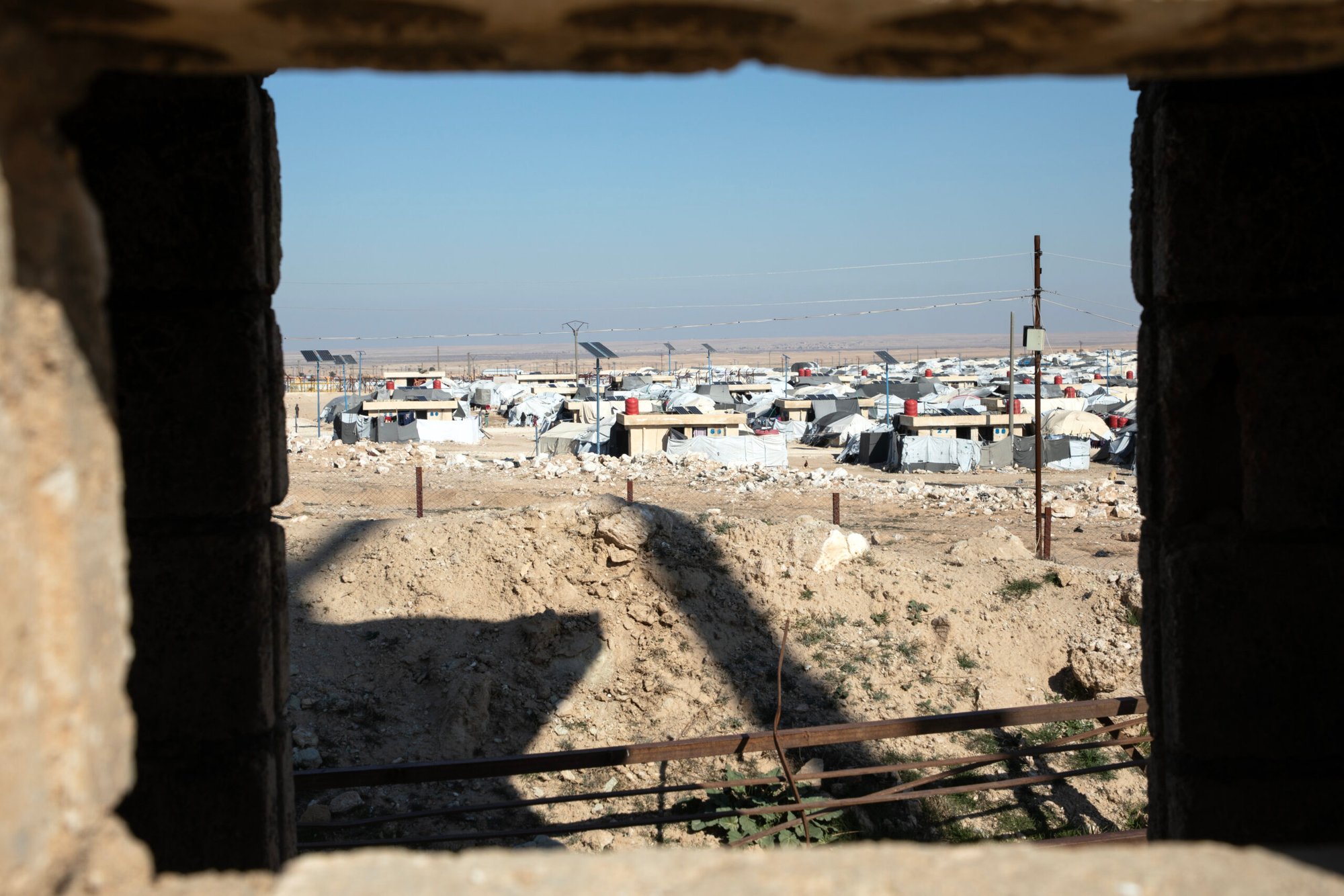



Cover photo: Located near the Syrian-Iraqi border, al-Hol was one of the largest and most controversial camps in Syria. ©Maryam Ashrafi
The road was no longer safe, but duty pressed her to try once more. For four years, Jihan Hanan had taken that forty‑kilometer stretch of blistered asphalt every morning after seeing her children off to school. And on January 20, 2026, when armored columns of the Syrian government were already laying siege on their hometown Heseke, she was bent on making one last run to “the most dangerous camp in the world.” The day would become her last as the director of al-Hol, the secluded tent city deep in the scrublands along the Syrian-Iraqi border.
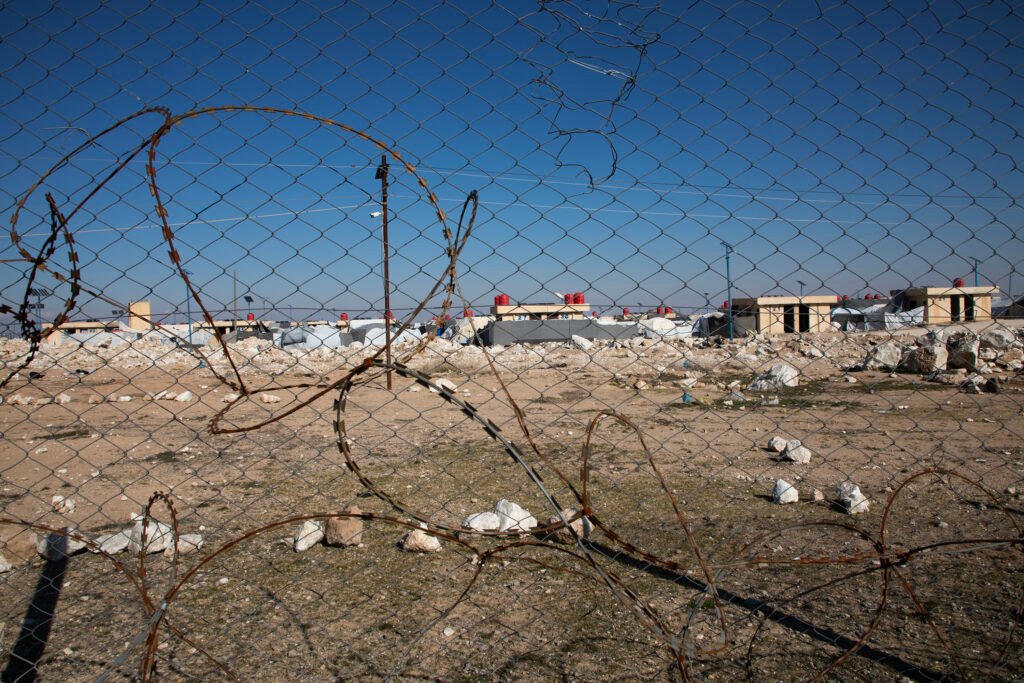
Cut off from the rest of the world by light-blue steel fences and coils of barbed wire, al-Hol housed tens of thousands of people from across the globe—suspected Islamic State (ISIS) militants, their family members, and locals displaced in the final battles to defeat its self-proclaimed “Caliphate.” Though as much as 95 % of the population were women and children, humanitarian and security officials routinely called the camp a “ticking bomb,” a lawless enclave where deplorable living conditions, daily violence, and clandestine ISIS networks nurtured a new generation of fighters for the terrorist organization.
As the head of the camp, Jihan’s goal was to see it emptied and closed for good. Sometimes enthusiastic, other times frustrated, she returned to the same point again and again: the clock was ticking, and only profound rehabilitation programs and repatriations could defuse the bomb. But the programs remained chronically underfunded, and foreign governments were reluctant to bring home citizens linked to ISIS’s brutal rule. Even if al-Hol’s population had more than halved during her four-year tenure, over 24,000 people, including 6,400 foreigners from 42 countries as far away as Malaysia and Finland, remained in the camp. On that January morning, Jihan’s long-held dream of seeing the camp empty suddenly turned into a nightmare.
When she and a group of humanitarian workers set off toward the camp, if only to bring bread to its inhabitants who lived perpetually on the brink of hunger, they quickly realized they were no longer in charge. The Syrian army had halted its advance at the gates of Heseke and was now pressing through the desert toward al-Hol. Emboldened by the chaos, local armed bands with murky loyalties were attacking checkpoints along the roads and some were already engulfed in flames. All Jihan could do was stay in the city and remain in phone contact with the handful of aid workers who were now locked inside the camp after their night shift.
Shortly after noon, her trapped colleagues called once again, now on the brink of panic, gunfire cracking in the background. The camp headquarters—Jihan’s office—had been ransacked and set ablaze, they said, along with the nearby office of the Kurdish Red Crescent humanitarian NGO. Within hours, videos from the camp flooded social media, showing flattened fences, crowds surging through the gaps, and government-affiliated gunmen cheering the runaways with manic “Allahu Akbar!” chants. Whatever fragile equilibrium had held the camp together for seven years was gone by mid-afternoon—the “ticking bomb” had finally exploded.
“When I saw everything going this way, truly, my heart burned,” Jihan later told me, still trying to assess the scale of the unfolding crisis. “This is not just our problem; this is a problem for all of humanity,” she warned.
But for her, the public face of the volatile camp, it was also deeply personal. When we exchanged voice notes over WhatsApp in the following days, she had already packed up her home in Heseke and fled with her family deeper into the Kurdish heartlands further north.
She was on the run again, for the second time in her life.
The camp without comparison
In early 2019, when the Syrian Democratic Forces (SDF) defeated the last remaining bastions of ISIS’s territorial rule, the terror organization had one more shock in store for the world. Crowds upon crowds of people poured out of its vast tunnel networks, shattering the wildest intelligence estimates. Up to 50,000 men, women, and children surfaced seemingly out of the desert itself—many at the edge of starvation and wounded in the clashes. The men of fighting age were imprisoned by standard, but women and children streamed toward al-Hol. Within a few months, the temporary screening site ballooned into one of Syria’s largest camps, sprawling across 320 hectares—an area of roughly six hundred city blocks—and holding 74,000 people.
The local security services linked to the Syrian Democratic Forces were soon overwhelmed by the influx of ISIS suspects from more than 60 different countries, and Al-Hol started drifting from temporary arrangement into something indefinite and ambiguous. Often described as a prison, sometimes as an IDP camp, it wasn’t really quite either in any conventional sense. The UN called it “a blight in the conscience of humanity,” and Jihan once described it as a “prison without doors”—a paradoxical phrase that since then stayed with me as the closest to the truth.
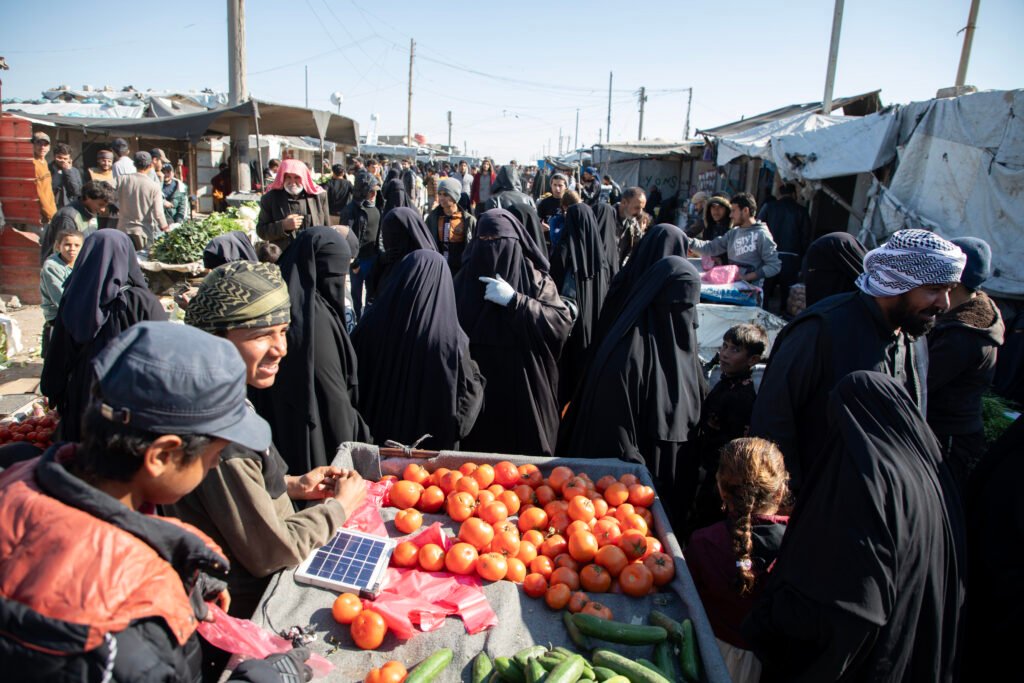
Besides the visible security cordon along its perimeter, al‑Hol looked much like any other refugee camp in the region—such as Washokani that arose around the same time in Heseke’s outskirts to shelter Kurdish families displaced by the 2019 Turkish invasion in Serekaniye. It had a Kurdish Red Crescent clinic, three UNICEF schools, a handful of other rudimentary NGO-run services, and rows after rows of once-white tents, beaten to varying shades of khaki by years of scorching sun and sandstorms. A modest but noisy “shopping street” sprung just a stone’s throw away from Jihan’s office, where women in pitch-black niqabs traded groceries, cosmetics, and household items for a meager independent income. But under the surface, al‑Hol was unlike any other camp.
“When humanitarian workers come inside the camp, they often face attacks. The children rain stones upon them, and sometimes the women in the migrants section attack them with knives,” Jihan told me in 2025, after overseeing the camp for three years. “Everyone who comes from the outside is an infidel to them.”
By “migrants section,” she meant the camp’s Annex, a separate wing holding thousands of foreign women who had allegedly traveled to Syria to join ISIS, along with their children. At the time of that interview, the foreigners’ section was closed to journalists, and Jihan insisted she could not guarantee our safety inside. All we could do was to climb on the nearby hills after the interview and watch small groups of children wandering its dusty streets without direction, stopping occasionally to hurl trash and or wave index fingers toward a lonely armored car circling slowly the camp’s perimeter.
Detained in the high-security section, the foreign women were widely seen as the radical core of ISIS in al-Hol. But the organization’s reach extended deep inside the bigger main camp that housed “locals,” meaning Syrian and Iraqi families.
“We can say that a ‘small state’ of ISIS exists inside the camp,” Jihan said, echoing a widely shared assessment among local and international security experts. It sounded dramatic, but there was nothing sensational in her voice–only the laconic weariness of a woman who has spent years fighting a battle with no clear end.
“We are trying to break this structure, but it is very difficult without international help,” she sighed.
When Jihan became the camp’s director in 2022, some 53,000 people were living in al‑Hol and the camp had just endured its most violent year on record. In 2021, more than two people were killed in al-Hol per week, and the camp’s homicide rate soared to levels rarely seen in civilian environments (three times higher than in the Sicilian capital Palermo at the height of the 1980s mafia wars). From then on, violence gradually declined with recurring, weeks-long raids to dismantle ISIS cells, but it never disappeared.
“Among the people in this camp, the mentality of killing is something normal; suicide is something normal; killing children is something normal,” Jihan assessed (in 2025). “Their mentality is very heavy… It’s still like that of ISIS. If someone is against their ideology, they may kill them.”
While she sometimes spoke in broad strokes, Jihan regularly reminded that not everyone in al‑Hol was loyal to the terror organization or even suspected of past involvement. In the “small state of ISIS,” as in any violent regime, mere survival often demanded some degree of collaboration. Much of the violence, Jihan said, stemmed precisely from the organization’s attempts to reproduce its former power structures inside the camp—most notably its Hisbah, the “morality police” that enforced behavioral control in line with ISIS’s fundamentalist worldview.
“The women who still strongly follow ISIS ideology establish their own courts [inside the camp],” she said. “If a woman wants to return to her country, or wants to save herself from that mentality, the Hisbah punishes her.”
To show what she meant, she suddenly picked up her phone and opened photographs of the most recent victim: a brutalized and decomposed body hidden deep inside the foreigners’ Annex. Alongside lashings, beatings, and the torching of tents, it was the kind of method ISIS used to keep women in line.
As Jihan went on recounting stories of women abusing each other and their children, her distress was unmistakably real. For her, protecting the camp meant not only preventing ISIS outbreaks, but safeguarding residents who wanted nothing to do with the group. She said many Syrians wished to return to their home regions, following the fall of the Assad regime two months earlier and renewed hopes for safe repatriation deals with the new powers in Damascus.
While the organized presence of ISIS in al‑Hol was universally recognized, no reliable estimates ever existed of how many in the camp embraced its ideology and how many sought distance. Between survival and allegiance, fear and fervor, remained a murky space of motivations the local security forces were never able to map. ISIS skillfully exploited that ambiguity, hiding its militants right beside the unfortunate who were drawn to the organization’s orbit—and eventually to al-Hol—by circumstance rather than conviction. Like its so-called Caliphate, also the “small state of ISIS” in al-Hol had its perpetrators and victims alike—and many who could be described as both.
According to their own testimonies, many had ended up the camp through a similar path: a chain of misfortunes that often began with the earsplitting roar of American or Russian air planes. They described the horrors of gravity bombs, inhumane poverty, and multiple displacements that pushed thousands deeper and deeper into ISIS territory—until there was no return. Some foreigners stood defiantly by their choices, but many claimed they had been groomed to Syria with false promises, or found themselves under ISIS rule through their husband’s decisions, forced marriages, or outright human trafficking.
In a recent Al-Jazeera video interview, one of the few men in al-Hol—supposedly a doctor from the neighboring Deir ez-Zor governorate—went as far as to claim that all people in the camp were “civilians,” meaning not ISIS members.
“When the Islamic State entered my area, I was forced to stay inside my house,” he said. “I’m telling you, one million percent, there’s no ISIS here [in al-Hol].”
Yet, within twenty‑four hours, social media users unearthed an older propaganda video from ISIS’s Al‑Furat channel that showed the same man brandishing a Kalashnikov, pledging support for the organization, and recruiting others to join it.
His story carried every sign of deception, but it highlights precisely the kind of ambiguity that defined the nature of al-Hol. Sometimes the stories were true, sometimes less, and sometimes the narratives of victimhood served only as a convenient camouflage for those who not merely survived ISIS, but worked on its payroll.
The sheer number of suspects, personal files, and nationalities—and the judicial complexity of prosecuting war crimes and crimes against humanity on a scale unseen since the Nuremberg trials—far exceeded the capacity of the local authorities, the Democratic Autonomous Administration of North and East Syria. Without international backing or recognition, most cases remained without conclusion.
Asked how she navigated that uncertainty and how she saw her own role in all of it, Jihan said it was not her task to judge or prosecute. She saw her work instead as a continuation of the humanitarian path she had chosen years earlier.
“I didn’t look at who they were or what country they were from,” she said in a recent phone call. “When I was serving that camp and those people, believe me, I did it from the heart.”
A warm pride entered her voice as she recounted her team’s small achievements: successful repatriations, orphans finding new lives, women coming out of ISIS influence, and Yezidi girls freed from slavery. Listening to her, al‑Hol began to feel less like a faceless “time bomb” and more like a melting pot of dispossessed individuals, each with a unique story and trauma but a shared longing for a better future. In that moment, I thought I began to understand what drove her and her team back to the desolate camp every morning.
Jihan’s long road to al-Hol
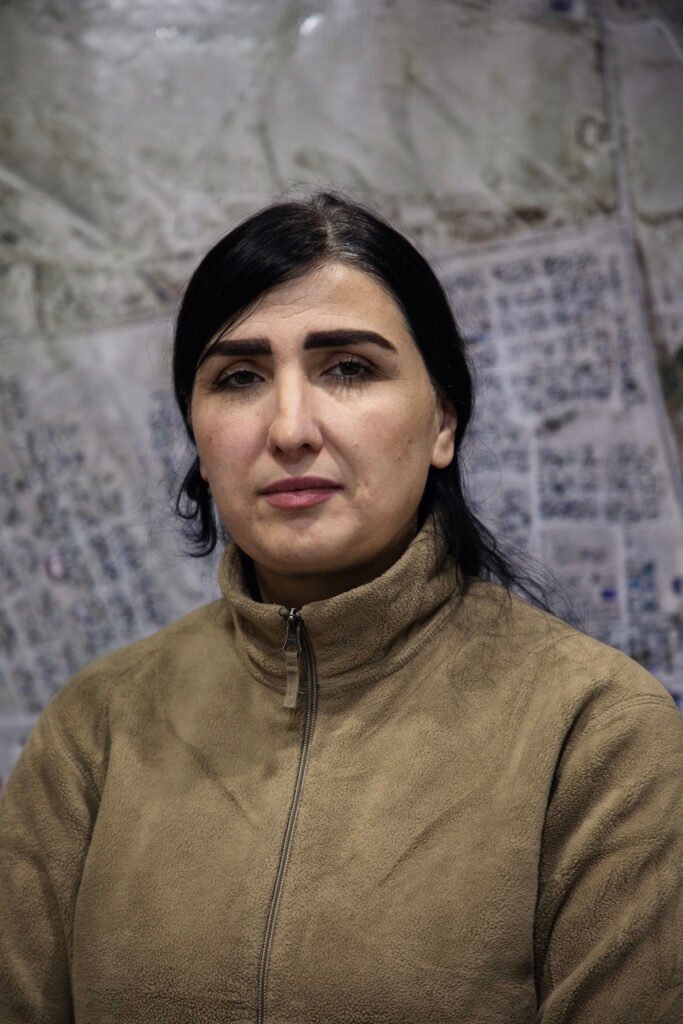
Over the years, Jihan became a steady presence in international media, likely one among the most quoted officials in north-eastern Syria. Every time something happened in al-Hol—which was often—she explained the complexities of the camp with the kind of fact-centered, measured parlance one would expect from a spokesperson. Her quotes were flat and brief, often paraphrased or profoundly impersonal. Yet, behind that stoic public image was a person deeply devoted to people whose lives the war had blown to pieces. By her own account, the same hopes and hardships that drove thousands of people to al-Hol also motivated her decision to become its director.
“Before, I was a housewife, taking care of my children. But after the revolution and the occupation of Afrin, my life changed,” she recounted in a recent interview. “I became a woman active in social and humanitarian fields.”
Jihan was born to a modest family in a hilltop village deep in the Kurdish heartlands of north-west Syria. Under the Assad regime, life in Afrin’s remote mountains was unassuming, moving largely to the quiet, communal rhythms of the harvest. Olive oil defined the region’s economy and identity, but Jihan’s home village Mirkan carried a small distinction of its own: an exceptionally prized strain of sumac, the crimson-red berry that gives a sharp, acidic edge to dishes across the Middle East.
The village was also notable for its high degree of education, particularly among its women, many of whom held university degrees despite the societal and institutional barriers that often prevented them from turning those diplomas into professional careers. “In the village, we grew up with Kurdish culture, and education was very important to us,” Jihan said.
She also left the village to pursue an academic path, though her studies came to an end after her baccalaureate degree and first pregnancy in 2010. When the Syrian Revolution erupted the following year, Jihan had just returned to Afrin to raise her newborn, unaware that soon her home region would be among the first to expel the regime forces.
“The revolution changed everything,” Jihan said, adding that for her the change was first felt at home. Her children could now study in their mother tongue, and she could raise them on a “national and cultural foundation.” It was a long-held dream for her and her husband.
But beyond linguistic and cultural rights, the revolution blew open the closed doors and class ceilings that defined social life during the decades of Assad rule. The institutions once reserved for regime loyalists were now opened to ordinary citizens, men and women alike. Self-governing communities started to pop up all across the Kurdish regions on the Syrian-Turkish border, and the fierce resistance of Women’s Protection Units (YPJ) underscored that defending the land was inseparable from women’s liberation, and vice versa. Their martyrs like Dîlar Gencxemîs from Jihan’s village rallied their home communities and millions across the world to the liberation movement.
“Arîn definitely had a huge impact on us, no one can forget Arîn,” Jihan said, referring to Gencxemîs by the nom de guerre she adopted in the YPJ ranks.
While commanding the resistance against ISIS in Kobane in 2014, Arîn Mirkan’s self-sacrificial stand became the defining symbol of women’s resolve to dismantle the forces of oppression, and a pivotal turning point in the Syrian civil war. From then on, ISIS started to crumble, and for women like Jihan, it was a living proof that women “can take the lead in every field.”
“Whenever I was asked about ISIS and the war, I thought about the work Arîn did in Kobanê to defeat ISIS and that I’m continuing it in al-Hol,” she said. “I mean that maybe we could complete that work in al-Hol, by dismantling that hostile mentality and returning those people to their homes.”
But for Jihan, as for many others, her long journey toward al‑Hol truly began only when the war reached her own doorstep. While the self-governing Afrin had become renowned for its relative peace throughout the years of civil war, life there was shattered abruptly in 2018 when the Turkish army and Islamist, pro-Turkish militias launched a cross-border operation to dismantle its experiment in self-rule. Jihan and her family were among nearly 300,000 Kurds who fled the region as it fell under an occupation defined by systemic human rights abuses that ranged from the destruction of ancestral olive groves and desecration of cultural sites to abductions, racketeering, and extra-judicial executions.
She said this personal experience of loss and exile ultimately defined her professional path. After restarting her life in internal exile in Heseke city, she was determined to work in the humanitarian field and help those facing similar hardships she had endured.
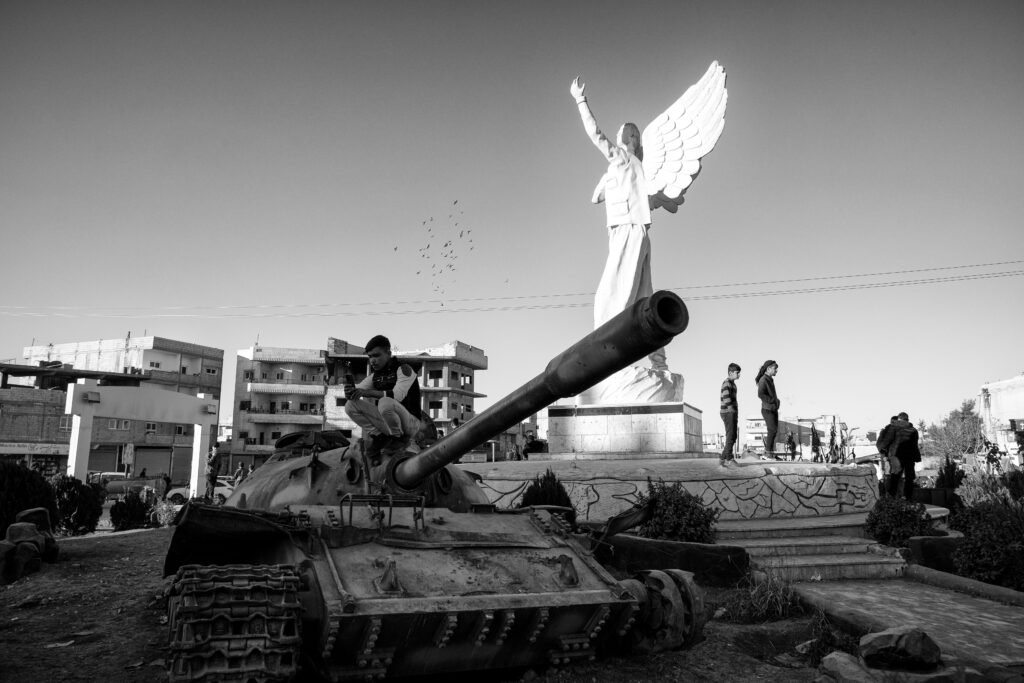
In 2019, Heseke stood as a haven of safety in central and northern Syria, located equally far from the Syrian regime and the Turkish border. The city hosted the Syrian Democratic Forces’ General Command and other key administrative institutions, and it was recovering fast from the years of war. Jihan, like many others fleeing from Afrin, sought shelter in its schools and neighborhoods, but they were hardly alone.
To the south of the city, the Arisha camp swelled with families from the neighboring Deir ez-Zor governorate as the last ISIS strongholds crumbled down. To the east, the Washokani camp rose from the dust as Turkey’s third invasion in Syria displaced more than 160,000 Kurds from the Serekaniye region. And there was of course al-Hol, forty kilometers farther in the desert.
For someone with a calling for humanitarian work, Heseke was full of opportunities, and Jihan soon found her first position in the Arisha camp. There, she gradually learned the workings of IDP camps until she was recruited in 2022 to manage the permanent emergency in al‑Hol.
“The administration found me suitable, because I knew camp management well,” she said about why she was picked up to the task.
When I first interviewed her in January 2025, she was already a seasoned manager, with three years of experience in Arisha and another three in al-Hol. Her passion for humanitarian work had not waned, but a new sense of frustration had grown on its side. She felt their warnings about the indefinite quagmire in al-Hol and their calls to empty the camp were not heard, while at the same time international human rights organizations scolded the camp administration for the life-endangering humanitarian conditions, arbitrary detention criteria, and other human rights violations in the camp. Jihan did not deny the problems, but she expected more constructive help to solve them.
“The international community does not give true and proper support to this project. They provide some food and medicine, but they ignore the ideological threat,” she said when I visited the camp in 2025. “There must be a political solution, as we cannot carry this burden forever.”
Asked about potential solutions, she echoed the Autonomous Administration’s long-standing calls: “An international court must be established here, or every state should take its citizens and prosecute them in their own country and rehabilitate them.”
At the time, al-Hol still held 37,000 people. Its population was slowly declining, but mainly due to regional developments. Repatriations to Iraq had increased since 2021, when Iraq turned away from the haphazard mass trials of ISIS suspects that often resulted in bulk death penalties. The Autonomous Administration of North East Syria had abolished death penalty on moral and political grounds and refused extraditions that risked capital punishment, but under the new UN-monitored repatriation framework, convoys of up to 600 people started leaving al-Hol to Iraq every few months. Meanwhile, for many Syrians in al-Hol—for whom a general amnesty had been issued already in 2020—the fall of the Assad regime in late 2024 made returning home finally safer than remaining in the camp. But more than 6,000 third country nationals remained in the camp, their numbers all but frozen as international interest in al-Hol sunk to historic lows.
“European states only take a small number of orphans, but they don’t want to receive families with ISIS ideology,” Jihan said, scrolling left-handedly a long table of nationalities on her phone. “Every day that passes, these children grow up and their hatred increases further, their ideology becomes sharper.”
Walking through the camp, one could feel the tension pressing against its fences. The positive developments in Iraq and Syria had clearly stirred hopes that al‑Hol’s indefinite limbo might finally end. That mix of expectation and frustration occasionally erupted into violence, vandalism, or looting, undermining the already fragile humanitarian situation and creating more frustration.
“It is a vicious circle that we are in,” Jihan said. “The [humanitarian] organizations are afraid, and if we cannot guarantee their safety, they will stop their work. And if services stop, the situation inside the camp will become even worse.“
In fact, only some hours before the interview, Jihan and her colleagues had prevented that vicious circle from turning into a full-blown death spiral.
Two days earlier, in the morning of January 25, Jihan had arrived in the camp to find out that the US government contractor Blumont–who supplied much of the food, cooking gas, clean water, and security personnel to the camp–had withdrawn all its 300 employees, including the guards, overnight. The newly re-elected US president Donald Trump had suspended all US foreign aid for six months, and for the people in al-Hol it meant literally a sentence to death by starvation. Adding an insult to the injury, the pullout had also halted a long-planned repatriation of 600 Iraqis scheduled for the same day, as Blumont managed also the camp’s database of personal files. Some warehouses in the camp were already looted for bread and conservatives before 60 guards of the Autonomous Administration’s Asayish (police) force came to the camp to prevent an all-out insurrection.
But on January 27, as our reporting crew jolted through the potholed desert roads far beyond the reach of mobile networks, the US government issued a special waiver for al‑Hol. Partly due to pressure from Jihan’s team and the NGOs, the camp was temporarily spared from the abrupt funding freeze that was estimated to risk more than 14 million premature deaths worldwide. Jihan didn’t say anything at the time, but I later learned that she had also broken into Blumont’s office and snatched their precious database to authorize the stranded Iraqis’ return to their home.
The “ticking bomb” did not detonate that day, but dark clouds shadowed Jihan’s thoughts.
“As the camp director, I am afraid… I am afraid that one day this camp will go out of control,” she said. “If an attack happens from the outside, or a riot on the inside… it will be a disaster.”
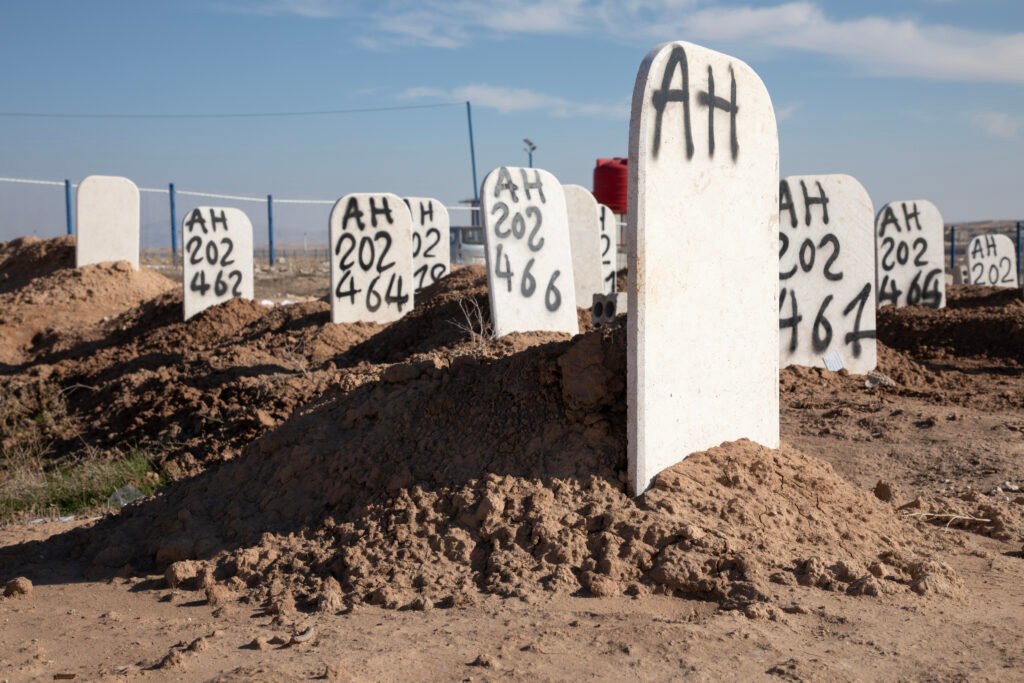
“We hoped that in the end, we would be recognized”
“This is your office, you pig Jihan—look at it!” a man says with a blank, weary face, aiming his words toward a shaky mobile camera. It is February 13, 2026, and he stands in the administrative headquarters of al-Hol.
Behind him, Jihan’s former office opens onto a scene of utter destruction: walls scorched black, ceiling panels shattered across the floor, and shreds of melted curtains clinging to bare window frames. Her writing desk has collapsed under debris, and the small portrait of the Kurdish leader Abdullah Öcalan that used to sit on the table in a small, wooden frame is nowhere to be seen.
The balance of local powers had tilted irrevocably after January 20, when the Syrian interim government wrested large swathes of territory, including al‑Hol, from the Autonomous Administration of North and East Syria. Aligning themselves with the transitional government, deep-rooted tribal and patriarchal powers—long held in check by the popular democratic structures—were now back on top, emboldened.
“God willing, I will have revenge for my son,” the man, likely in his fifties, continues in Arabic. He sports a white, trimmed beard and short hair, and a thick, black winter jacket over a qumbaz, the traditional ankle‑length robe favored among Syrian working classes. He could be practically anyone—just another laborer, farmer, or neighbor from the region or the adjacent Deir ez-Zor governorate.
”I am in your office now and by the will of God Almighty, I am coming to you. Even if the earth swallows you, I will come after you, you pig, you enemy of God.“
The video went viral on Syrian social networks and soon found its way to Jihan’s phone screen. She recognized the man immediately. He was from the camp and she had met him some times, trying to help him get his son out for hospital treatment.
“I told him that I couldn’t get the security clearance for his son, but I helped with everything else I could,” Jihan explained in a recent phone interview. “I was very cooperative with him, but he just said ‘no, I want my son to leave.’”
The man’s son Anwar was one of those who grew up in al-Hol’s purgatory because his father never got a security clearance. Now the blame for it fell on Jihan, who sounded not only afraid, but also genuinely disheartened by the fallout.
“Why did he make that video? Why did he threaten me by name?” she asked me, rhetorically of course. “He knows my work well—I am not from the security department to give permission for everyone to leave the camp. I was very helpful to him and his children too…”
Jihan said she had been threatened daily when while working in the camp, but that video was the most direct threat against her and her family since the violent takeover of al-Hol on January 20. By mid-February, when the video was shot, the camp was already practically empty, hollowed out by uncontrolled mass escapes and the moonlit business of smugglers along its fallen fences. The threats carried a new weight now.
“As someone who was involved in this work… yes, I am very afraid,” Jihan said. “Because when ISIS originally started, it began in this way. Prisons were broken into, camps were emptied… and now we see the same thing repeating. 2014 is not far off; it is still in our memories.”
As a security precaution, Jihan and her family had moved away from their house in Heseke already before that video surfaced on social networks. In their new surroundings, her two older children, both teenagers now, can still attend school. But Jihan herself keeps to the shadows. For the past two months, she has been mostly at home with her third child who is far too young to understand their abrupt flight from her birthplace.
Jihan asked their precise location to be omitted for security reasons, saying she would watch at least for a month how the situation in Syria develops. According to her, this is the first time in the fourteen years of war that she has considered seeking refuge outside of her homeland.
It has been safe until now, but the security conditions remain volatile amid the fragile integration of the Autonomous Administration and its self-defense forces into the Syrian state led by a ISIS’s rival al-Qaeda offshoot, Hayat Tahrir al-Sham. While the fate of the thousands who fled al‑Hol remains a massive, looming question mark, outbursts of ethnic violence against minorities stoke fresh fears.
“Now, those people who left al-Hol, we don’t know where they went, where they are, or who they are with,” Jihan said. “When I was at the camp, many countries didn’t want to take their citizens back. Now, which country knows where their citizens are? No one knows.”
Asked how she felt about the camp closing down in the way it did, Jihan called it bluntly “disgraceful.” For her, it was a disaster that could have been prevented a long time ago. Even so, she did not seem regretful, but rather proud of the work her team had carried out over the years with minimal resources.
“Despite all the difficulties and the attacks currently facing us, we will not give up our achievements,” she vowed.
Yet, in our last interviews, she also talked openly about her worries and her creeping disillusionment with the institutions and organizations that had worked with her administration in al‑Hol. Despite the obvious, mortal danger hanging over all those who ran the hazardous camp, she said, no foreign government or NGO had reached out to them to offer support.
“We hoped that in the end, we would be recognized, that our effort would be seen,” she said. “At the very least, we hoped to be told, ‘You stayed under this threat for so many years and provided this much service; now we will protect you too.’”
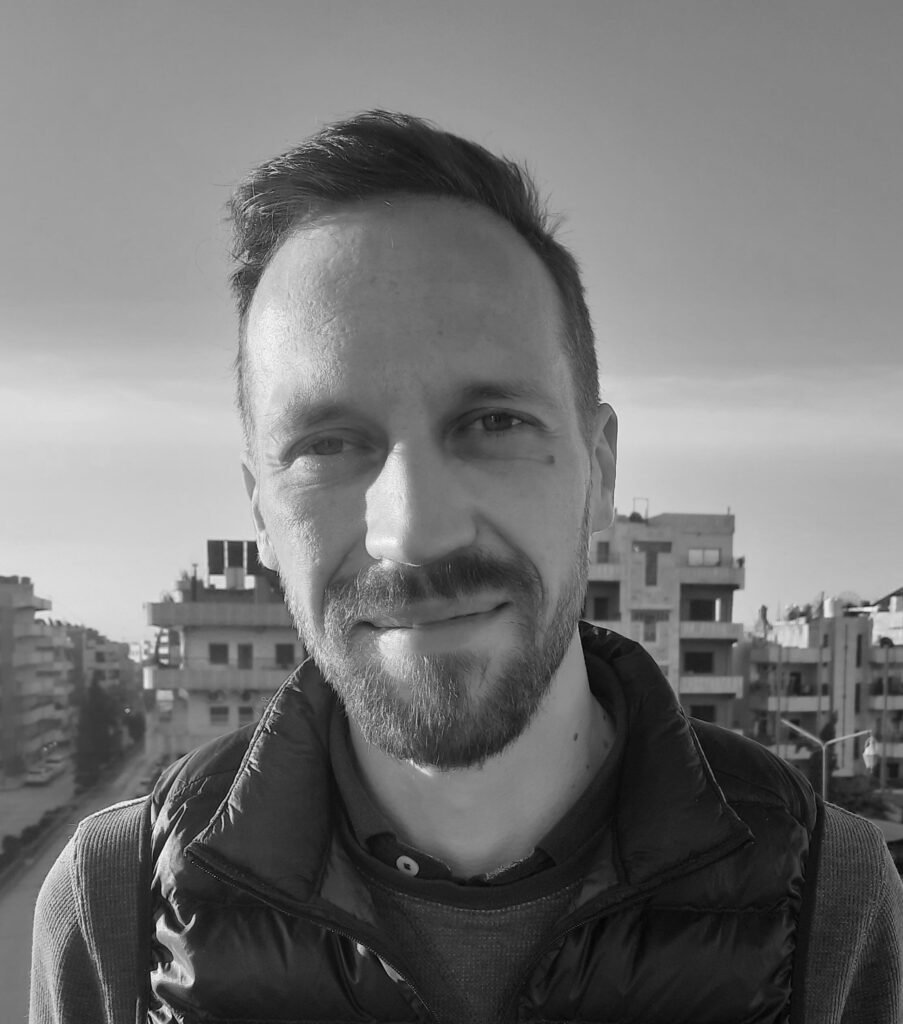
Henri Sulku
Henri Sulku is an editor at Turning Point magazine with focus on political economy, people’s history, and resistance movements.