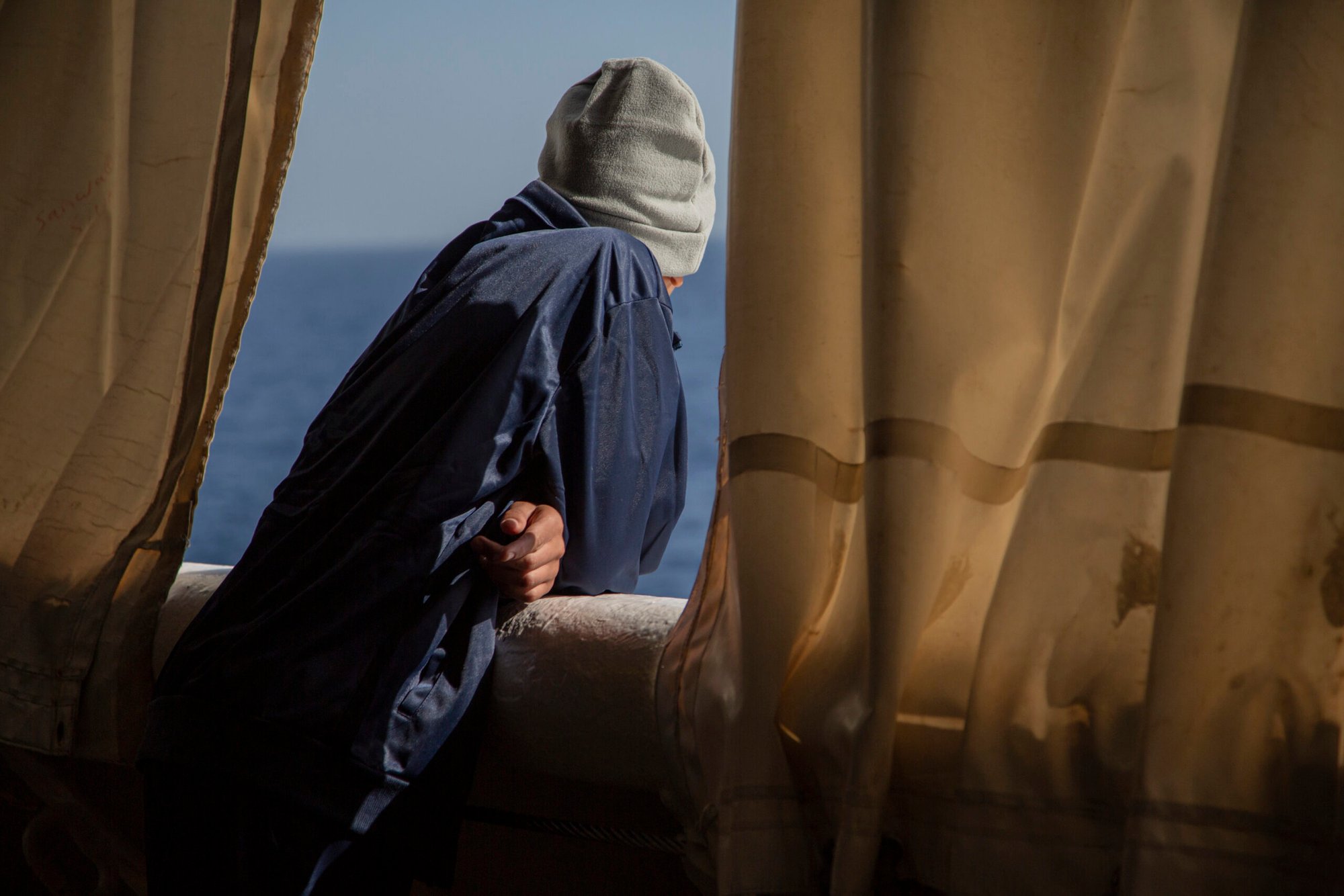



“They came at night. No explanation. No questions. Just orders.” Aisha repeats the sentence without hesitation. Her voice is firm, level, almost detached from the violence it contains. It is not the tone of someone searching for words, but of someone who has already decided what must remain.
The setting around her comes into focus only gradually: we sit inside a bright room in the European Parliament. Light pours through the glass walls, flattening shadows and illuminating a space designed for clarity—rows of microphones, translation booths, screens projecting findings. A place built to make things visible.
We meet Aisha at the sidelines of the Women State Trafficking report presentation. The investigation behind the report was done by the research group Rr(x), an international collective operating under a shared pseudonym, supported by a network of civic organizations including the Italian Associazione per gli Studi Giuridici sull’Immigrazione (ASGI). Their work reconstructs the immigration system across borders, tracing its continuity through testimonies, field data, and cross-checked accounts.
Aisha is from Cameroon. She says she feels safe now. That she can finally rest. But safety, in the way she talks about it, is not an endpoint. It is a position from which to speak. And what she describes begins far from here, inside a system that stretches across Tunisia and Libya, connecting state policy to fragmented power, and both to the priorities of Europe.
Between June 2023 and December 2025, at least 7,400 people were caught in what the researchers define as a chain of collective expulsions and trafficking from Tunisia into Libya. The sequence is structured and repeatable: arrest, transfer, detention, expulsion into border zones, handover or sale, and detention again—often tied to ransom. It is not the collapse of governance, but rather its expression.
In Tunisia, the system rests on a strong state. Since early 2023, following public speeches by President Kais Saied, Sub-Saharan migrants have been increasingly targeted through a security-driven approach: police raids in urban areas, arrests along transit routes, and systematic interceptions at sea, particularly off Sfax. The Tunisian National Guard has become a central operational actor in this architecture, supported by European funding aimed at strengthening border control capacities on the Mediterranean’s southern shores.
The operational chain is clear. Interceptions at sea are followed by transfers inland. Arrests in cities feed into the same network. Barracks, temporary facilities, improvised compounds, and other holding sites absorb these flows. Among them, the Garde Nationale barracks in El Meguissem stands out as a recurring node: a place of concentration where individuals are held briefly, processed informally, and then redirected.
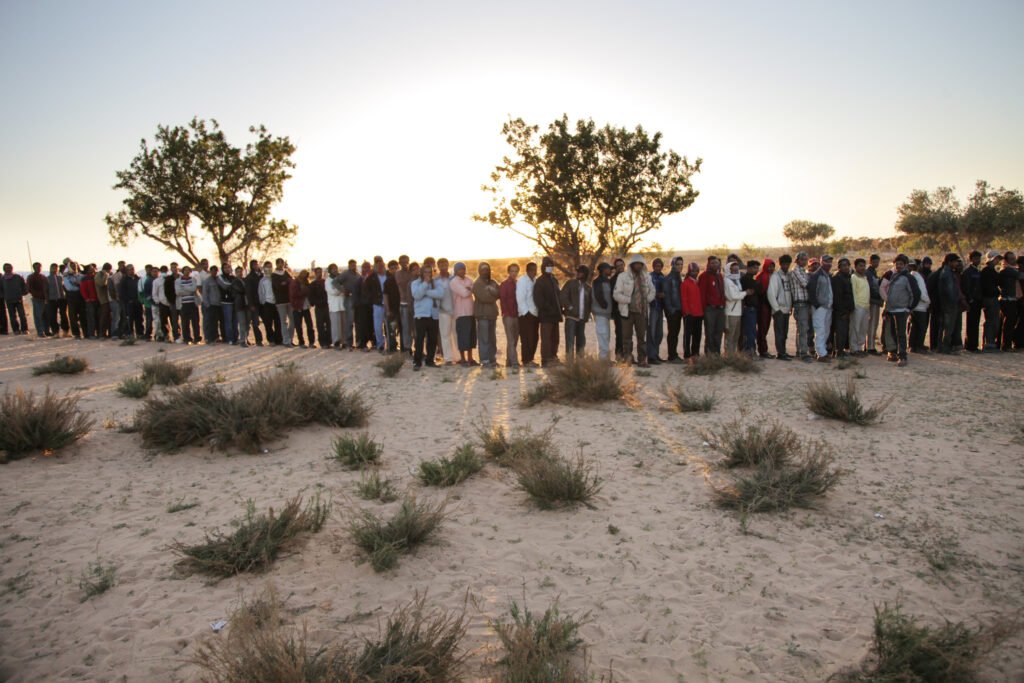
Beyond that point, the process becomes less visible. Migrants are transported toward desert areas along the Libyan frontier and expelled—often without documentation, formal procedures, and oversight. In July 2023, President Kais Saied warned his people of a potential “demographic replacement of the local people with sub-Saharan race” likely organized by Europe: a hateful speeh that led in a few days to mass raids and attacks across Tunisia.
Fati and her 6-year-old daughter Marie were expelled from Tunisia along with hundrends of other foreigners. A photo of them dead in the desert spread on social networks, highlighting the severe dangers and human rights violations faced by migrants in that region. A few hours after the picture went viral revealing the brutality of the Tuniasian Government, European Commission President Ursula von der Leyen and Italian Prime Minister Giorgia Meloni traveled to Tunis to formalize a migration agreement.
While Marie and Fati did not make it, thousands of those who have been expelled since then into Libya ended up in the detention system that often overlaps with the human trafficking network. Along the western corridor—from the Tunisian border through Al-Assah, Zawiyah, and into Tripoli—control is distributed among armed groups, state-affiliated units, and hybrid structures that shift over time. Some operate under formal ministries, others maintain autonomy while retaining access to state resources. The distinction is often blurred, especially in sectors like migration control, where detention, interception, and transfer generate both political leverage and economic gain.
Over the past year, efforts have been made to impose greater structure on this landscape. Registration systems have been expanded. Coordination between coastal units and inland facilities has increased. Interception capacity at sea has been reinforced through equipment, training, and logistical support.
But these technical layers do not replace the underlying political reality. In May 2025, the killing of Abdel Ghani al-Kikli—known as “Ghneiwa”—triggered a significant shift. Kikli had been a central figure in Tripoli’s security architecture, commanding forces that controlled strategic facilities, including detention centers and key infrastructure. His influence extended across ministries and informal networks, making him a crucial broker in the migration system. His death did not dismantle that system. It redistributed it.
The Department for Combating Illegal Migration (DCIM), formally responsible for detention centers, was officially dismissed in the aftermath. In practice, its infrastructure continues to operate, but without the same central protection. Its director, Mohamed al-Khoja, long associated with Kikli, has been sidelined.
In the vacuum that followed, other actors moved quickly. Forces aligned with the Zintani network have expanded their influence, both militarily and institutionally. This shift is reflected politically in the growing prominence of Interior Minister Imad al-Trabelsi, whose authority increasingly intersects with migration management. Control over detention sites, interception routes, and transfer mechanisms has begun to concentrate, though not in a way that eliminates competition.
Zawiyah remains one of the key points where this system becomes visible. Its detention facility functions as both an official reception center and a site of prolonged confinement. Migrants intercepted at sea are brought there, sometimes registered, often held for undefined periods. Conditions fluctuate: overcrowded cells, limited access to healthcare, restricted communication. Authority inside reflects the outside—layered, negotiated, unstable.
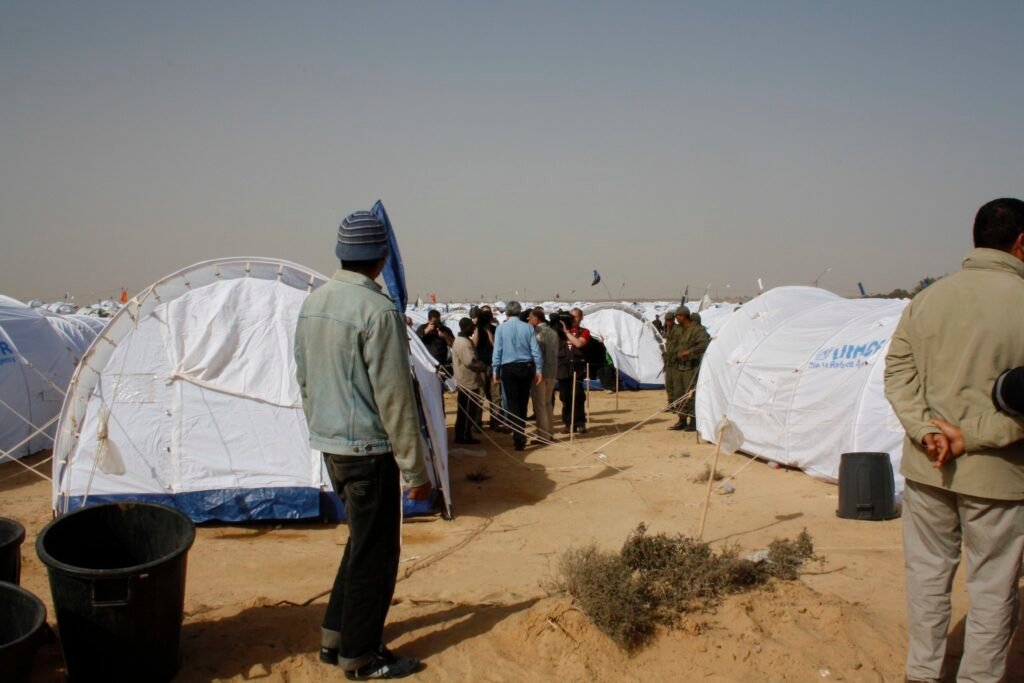
Further inland, Al-Assah operates as a transitional zone near the Tunisian border. It is a place of passage, but also of suspension—where migrants are temporarily held, redistributed, or transferred between actors. Movements are often undocumented, shaped by local control and shifting alliances.
Beyond the western corridor, Libya’s division is not just a background condition—it is an active fault line shaping the system. The eastern authorities, with their own military structures and territorial control, maintain a parallel order that competes rather than coordinates with the west. There is no unified chain of command, no shared framework. What exists instead is a fragmented sovereignty, where control over territory, institutions, and resources is constantly renegotiated.
In this landscape, European funding enters the system as a resource to be contested. Financial flows, equipment, and training programs directed to western-Libyan actors—particularly those able to intercept migrants or manage detention—reinforce existing asymmetries. They strengthen some networks while marginalizing others. They create incentives. Control over migration routes, detention centers, and coastal interception points becomes not only a contest over governance, but over access to international funding and political legitimacy. Migration management, in this sense, feeds directly into Libya’s internal competition.
Armed groups and state-affiliated units position themselves as indispensable partners, capable of delivering results that matter externally—reduced departures, increased interceptions. In return, they gain leverage internally: resources, recognition, and a stronger foothold within the shifting balance of power. The result is not stabilization, but a reconfiguration of conflict along new lines, where migration control becomes part of the struggle.
The fault lines are therefore not only geographic. They run through institutions, alliances, and funding channels. They determine who controls detention sites, who manages transfers, who speaks on behalf of the state. For European actors, this fragmented environment is not incidental—it is navigated, managed, and, at times, instrumentalized.
In Tunisia, engagement is direct: agreements with a centralized state capable of translating political commitments into immediate enforcement. In Libya, it is transactional: support distributed across a spectrum of actors, calibrated to secure cooperation in specific zones. Funding, training, and equipment function as bargaining tools, tied to measurable outcomes—primarily the reduction of departures toward Europe.
Migration control becomes embedded not only in foreign policy, but in Europe’s domestic political cycles. Pressure to reduce arrivals—particularly in electoral contexts—drives urgency and shapes partnerships. Externalization becomes the governing logic: containing movement before it reaches European borders, regardless of the structures it reinforces on the other side.
Tunisia and Libya, despite their profoundly different political systems, are thus drawn into the same architecture. One provides centralized enforcement. The other absorbs and redistributes control through fragmentation.
And across both, European funding acts not only as support—but as a force that reshapes the very terrain on which power is exercised. Within this framework, a new emphasis has emerged.
Alongside interception and detention, removal has become central to migration control. Voluntary Humanitarian Return flights, coordinated by the International Organization for Migration, have increased in scale. Formally based on consent, they offer a pathway out of detention. In practice, within a system defined by limited alternatives, they often function as the only exit.
The architecture is complete: interception, detention, redistribution, return.
Aisha’s journey moves through it. She does not describe the system in analytical terms. She marks its points—arrest, transfer, expulsion, confinement. Her testimony aligns with others, forming a pattern that connects decisions taken in rooms like this to consequences far from them.
In the European Parliament, that pattern is translated into data, diagrams, policy language. But Aisha’s presence interrupts that translation. She sits still as the discussion unfolds. The light remains constant. Voices move between technical explanations and political framing.
Her voice, when she speaks, does not tremble. It holds. And in that steadiness, the system—structured in Tunisia, fragmented and militarized in Libya, sustained through European policy—takes on its clearest form. Not as abstraction, but as sequence. A sequence that continues beyond the room, along the same routes where it began.
Nancy Porsia
Nancy Porsia is an Italian journalist, documentary filmmaker, and writer from Matera specializing in the Middle East and North Africa, whose work from Libya, Palestine, Iraq, Syria, Lebanon, and Tunisia has been published by outlets including Rai, Sky TG24, The Guardian, and Al Jazeera. She was the only Italian journalist based in Libya from the end of the Revolution until 2016, covering the civil war and investigating migrant trafficking networks. Since 2017 she has focused on migration from the Horn of Africa, particularly Eritrea, and works as a consultant on migration and security, while authoring Balas Para Todas (2021) and Mal di Libia (2023).