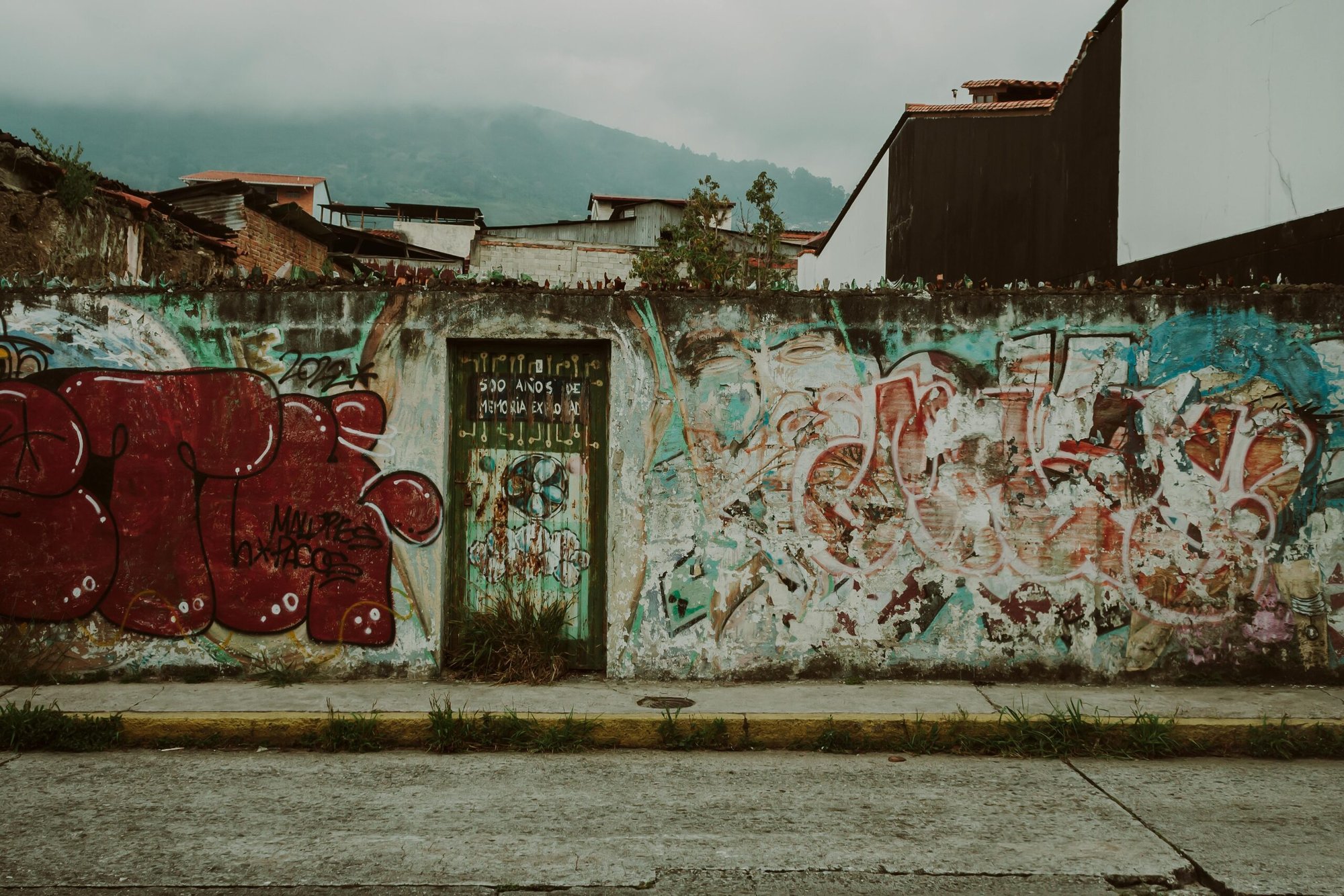



Cover photo: A street in Mérida, Venezuela. Photographer Arturo Anez.
To keep up with the rapid geopolitical changes, in February Turning Point is publishing video greetings from the ground. We look for informed local perspectives for what is actually going on, what is the atmosphere in the society, and what the rest of the world should know. The first of the political hot spots is Venezuela, from where we hear Emiliano Teràn Mantovani.
Greetings, my name is Emiliano Terán Mantovani, I am from Caracas and I am a [sociology] researcher at the Central University of Venezuela.
What is happening today at the social level, at the territorial level, in the face of the crisis that has been going on for more than a month after the US intervention?
First, Venezuelan society has certainly suffered a strong impact, which involves foreign forces entering the country, especially the main city, Caracas, and removing the president. But it is also very important to say that Venezuelan society has been through years of significant trauma, a trauma caused mainly or fundamentally by the Maduro government, a corrupt government, a government that has installed a dictatorship. Or rather a very harsh dictatorship of persecution, imprisonment, and censorship, coupled with an economy that has become criminal, in which the social class is even more impoverished than before, with 80% of the population living in extremely precarious conditions in contrast to the opulence enjoyed by the government elites.
There is a history of trauma that is now entering a new phase with the shock impact of the US intervention. The days that followed raised many questions about repression, which was not necessarily entirely justified. Especially during the first week, there was a deployment of para-state forces, hooded men controlling people’s phones, cars, and movement. But gradually there have been certain political tensions.
Today we see, let’s say two characteristics that are seen and felt by the majority of the population. First, a great deal of uncertainty. And second, especially among the most mobilized sectors, a renewed momentum for mobilization in a context where there was a lot of fear after the electoral fraud of July 28, 2024, when mobilization was practically eliminated entirely by the harsh repression that came from the government. In recent weeks, especially following the release of political prisoners and the amnesty—the proposed amnesty—a little over 400 political prisoners have been released, but more than 600 remain in prison. Also, the releases have been conditional; the released people are not fully free, but some have been subject to house arrest or other reporting requirements.
However, we have begun to see, especially in recent weeks, a mobilization of the families of political prisoners, of students, and unions, which we had not seen before. This is quite positive in a way. But it must also be understood in the context of great confusion among the population, who do not quite understand the association between the Trump administration and the new government of Delcy Rodríguez, which has many traits of continuity with the previous regime. In that sense, there is a lot of confusion, but I think it is true that a significant part of the population has expectations that can be understood as positive. Any change from the previous situation, will be seen as something positive.
Keep in mind that the minimum wage in Venezuela was not even a dollar a month, and public services are completely destroyed. The economic situation at the end of 2025 was the worst inflation in the world again, and the repression has been very harsh. This is why it seems that for the people, any change is seen as something good. And it is very paradoxical because this will come, let’s say, hand in hand with an intervention or a takeover by the Trump administration, as if they were going to govern Venezuela or be the new owners of Venezuela. It is very contradictory, but it has to be understood in the context I am explaining.
What forces are at play in this situation? Well, we clearly have a US government that is imposing itself by force on a country that is obviously much more fragile, as in the case of Venezuela. They are, let’s say, using force to impose not only the removal of a president but also a series of laws and regulations that are absolutely favorable to the United States and that are not in line with either human rights or the Venezuelan Constitution, which is the main document governing politics in Venezuela.
Even though I said in my previous answer that Maduro was not wanted by the people, that in no way justifies this new governance that Trump is proposing.
The other player in the game is the government, the Chavist regime, because it is a regime that has proven to have the capacity to control and govern the country by controlling both the main industries and the weapons. They have a monopoly on governance through a very broad structure of groups and armed forces, as well as through the party’s own cells. It is this capacity that actually gives it a chance to remain in power for a while, although we do not know for how long.
The Venezuelan opposition is not a single entity but rather several oppositions. But the opposition, at least the one led by María Corina Machado, does not have that capacity even though it has the majority of popular support, as evidenced in the 2024 elections. It does not have the strength to create or sustain governance in the country and is therefore being excluded from the current power equation, which is subordinate to the United States. The other, more predominant opposition has been completely tamed, although there is a more combative left-wing opposition but it is small and has little strength.
Finally, there are powerful civil society actors, the vast majority of whom oppose the government and try, especially the most organized sectors, to mobilize for change and to promote an opening towards democracy, which is not on the table before or during Trump and Rodríguez’s government, nor are elections or respect for the Constitution.
There is also a component that we could place between 20 and 25% of the population, that still supports the Chavist project. They have mobilized well, but it is also not very clear who the current regime is, because there are rumors that they may have handed Maduro over [to the US]. There are, of course, suspicions of treason and it is really difficult to know who is who in that context.
From my perspective, what the world should know, especially when trying to look beyond the mainstream media and the government line of the Chavist regime, which are the two major channels of communication that dominate the rest, is this:
First, the Trump administration and the current government of Rodríguez are not addressing the most important issues facing Venezuelan society. Venezuelan society may be heterogeneous, but its main demands are about democracy, freedom, and surely the recovery of the subsistence economy, the economy of the minimum. Within Venezuela’s heterogeneity, we can see different political positions, but everyone agrees that oil should be managed by Venezuelans and that Venezuela should be governed by Venezuelans. This is not currently respected, and it is essential to demand democracy at this moment, in this very complicated context. It is important to mention that the current government of Rodríguez is a government that has no social base whatsoever, not even among the Chavist sectors. It is not a government with popular support.
In the case of María Corina Machado, she is a leader with significant popular support. But what we really see in these two options, the government of Rodríguez and the government of Machado, is that both have a plan to plunder, loot, and hand over the country to foreign capital in the name of economic recovery. They are not putting on the agenda the most important issues that matter to the population, even though Machado is certainly more popular today than the government of Rodríguez could ever be. In this case, it is essential to demand respect for human rights. Political prisoners have not been freed, not even by 50% at this point. They continue to be bargaining chips.
The environmental situation in Venezuela is serious, and it is not on the agenda now. The parliamentary question in the absence of the president, which logically should arise if there is an acting president, is the call for elections. The Venezuelan people have the right to elect their leaders. The people want and need an end to the persecution by the current political regime, which continues to terrorize the population despite the release of political prisoners. Above all, the end of this repression would allow social and political forces in Venezuela to reorganize so that an alternative to these projects can also be strengthened. Because, unfortunately, there is a fight for which of the two leading forces will hand over the country in a more open way to please international capital, and that goes against all principles, social rights, and the Constitution.
And, of course, it is essential that from outside, at the international level, there can be greater communication and dialogue between social sectors in other countries and social sectors in Venezuela that are involved with human rights organizations, community leaders, the political bases of some political parties, environmental groups, unions, women activists, teachers’ groups, nurses, etc. And that sector needs, of course, to establish much clearer communication with the outside world in order to also have a different view of Venezuela, alternative to that presented by the mainstream media and the Chavist regime, which do not represent the population.