

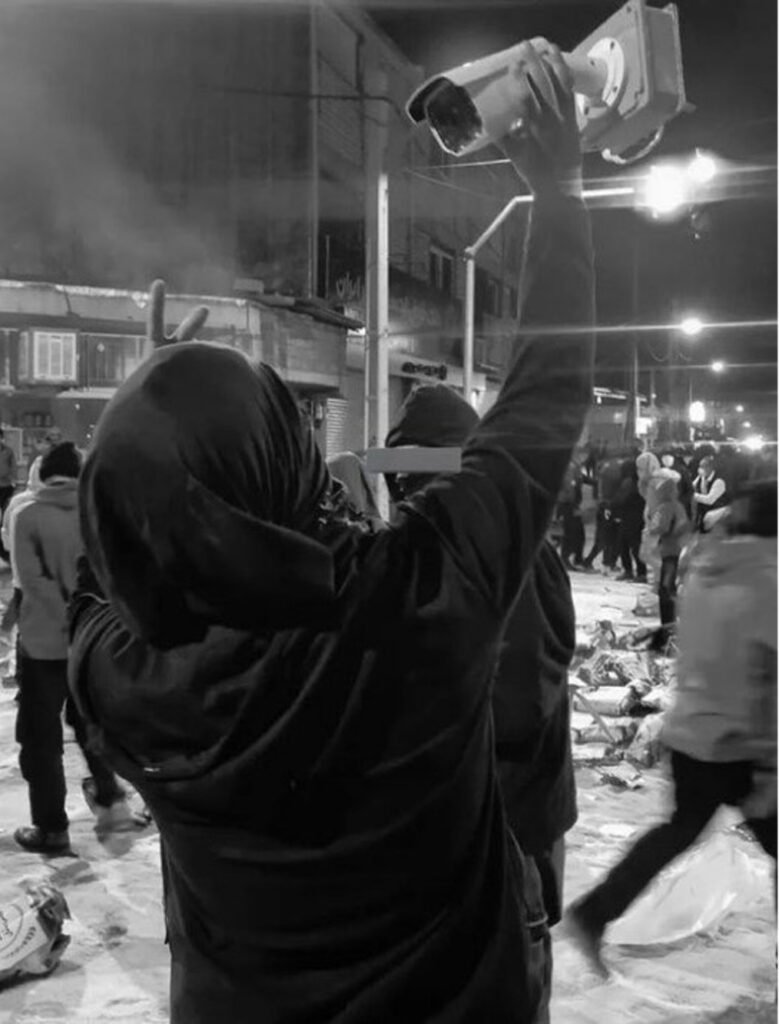
Social media footage
January 6, 2026, Abdanan, Iran.
Protesters on the streets in Abdanan, Iran on January 6, 2026.
Iranian Journalist: We Need to Turn Grief Into Resistance
February 25, 2025
To keep up with the rapid geopolitical changes, in February Turning Point is publishing video greetings from global hot spots. We look for informed local perspectives for what is actually going on, what is the atmosphere in the society, and what the rest of the world should know. In the second post we hear from the Iranian journalist Shekufe Ranjbar.
On the 8th and 9th of January this year, at a time when much of the world was likely celebrating the New Year, innocent and unarmed people in Iran, who were taking to the streets in cities across the country—in a lot of cities actually—to protest the harsh living conditions and really lack of basic freedoms were met with deadly live ammunition.
Tens of thousands were killed on the spot and this is just what we have so far realized and the extent of the real crime is not really known to us yet. All we know is that the streets resemble the bloodbath that we can even see in the footage that has emerged from Iran since then, which is definitely only a tiny fraction of what actually happened. And all of this occurred while the regime was fearing the spread of protests and the flow of information abroad, so it had completely shut down the internet.
Just a few days ago, people in Iran commemorated the 40th day since the killings. This is called Chehelom. In the Iranian culture, the 40th day or Chehelom marks a gathering held 40 days after a person’s death to honor their memory. The massacre is without a doubt among the bloodiest and very likely the largest and most violent instances of Iranian citizens being killed by the Islamic regime.
These days, the internet has been partially restored, of course, and people are once again more connected. But nothing is as it was before, I am hearing. Many have lost their children and friends or seen them arrested. The situation is really extremely harsh, perhaps even unimaginable for many people.
According to witnesses, literally wherever you look around in the city, you are likely to see a memorial erected for some people who were killed. The city is in mourning and so are the people.
But Iranians know how to turn this grief into something greater, into action. Because for many years they have been forced to struggle against the ruling system and each time they have seen deadly violence meted out against them. Of course, on a smaller scale, I would say.
So for better or worse, they have learned to sympathize with one another and to respect one another’s pain. For example, I know people gather in small informal groups and talk about the heavy emotions they are experiencing these days. Emotions like being somewhere between mourning the death of young people; frustration with the existing conditions; and really despair and disappointment over the possibility of change. And a constant sense of insecurity—don’t forget that—which is driven by the ever present threat of war.
It is, I would say, entirely understandable that under such circumstances, some people might view war as a blessing, because all the civil paths towards change in Iran have already been tried by them. I’d like to talk about two examples, just two very prominent ones. Like in 2009, they fought for their votes in a in a regular election. In 2022, as you might better remember, they rose up against compulsory hijab and many other civil restrictions. And these two are just only two examples of the countless visible and invisible efforts they’ve made to bring about change, only to be met with repression every time. So people are exhausted and disillusioned.
It’s understandable, I would say, that some believe a military attack might dismantle the system of repression. But at the same time, a war is a war, and no one knows what consequences it could bring once it begins. So, as a result, many people carry this legitimate fear that the situation in Iran feels like being trapped between two terrible options, knowing that neither the continuation of the current situation nor a war would offer any hope.
And yet, as I mentioned earlier, these people understand solidarity. So today, they have turned mourning into resistance at many funerals and Chehalom memorials, as I explained. The families of those who have been killed dance, actually. They dance in grief. They recite poetry and ask people not to cry, but instead to keep the memory of the fallen youth alive so that freedom—the very thing that people have always sought and fought for—might one day materialize.
It’s a deeply difficult moment, I’d say. Frustration, born out of a lack of tangible change and the trauma of the mass killing, the fear of war, and at the same time, a hope that the situation cannot last. All of them exist at the same time. So people believe that the blood of the fallen will not be in vain.
No one knows what the near future holds for the people of Iran, especially with this threat of war being very around and increasingly looking possible and likely. But one thing is clear to the people and it’s that nothing, even life itself will never return to how it used to be before the recent massacre, just as in 2022 when Mahsa Jina Amini was killed over hijab, and people said they would never return to the conditions that existed before her death.
So through daily and persistent struggle, women managed to significantly alter the reality of compulsory hijab. A similar condition, I would say, prevails today. People were able, while unarmed, to achieve tangible progress on compulsory hijab. So they know how to hold on to the hope that by refusing to return to the pre-massacre status quo of life, and by continuing on the path stained with the blood of people, this time they will reach further victories and hopefully, ultimately, freedom.
But no one knows exactly how—obviously. But the hope exists and people are hopeful while very frustrated.