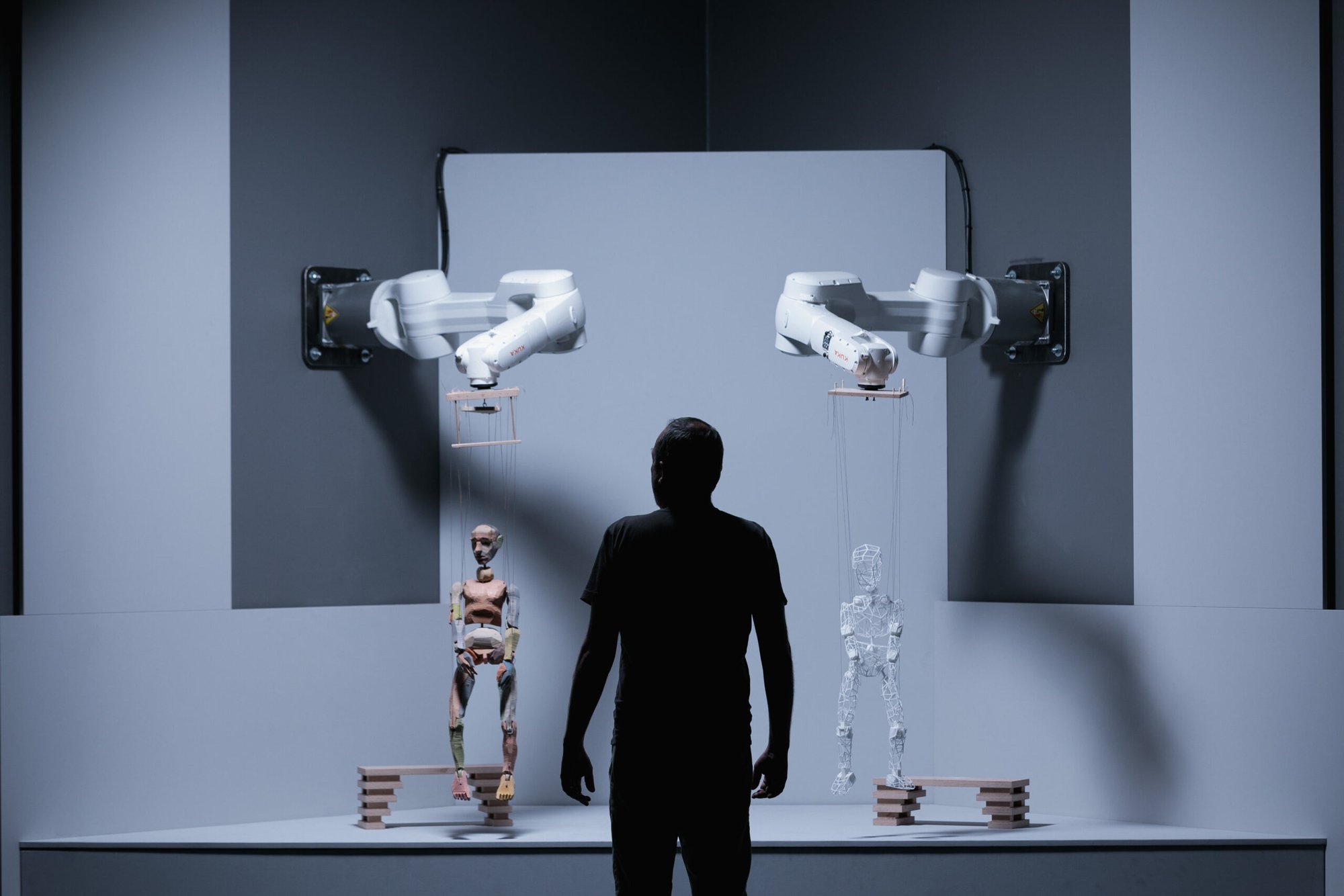



Cover photo: Two marionettes are directed by robotic arms in this art piece using creative robotics. CC Florian Voggeneder
Every afternoon around four o’clock, Mr. Huang lowers himself carefully into the same worn armchair beside the window of his nursing home in Hangzhou, a rapidly expanding city on China’s eastern coast. He used to see his son and grandchildren every week. Now they visit two or three times a month—sometimes less.
“They’re busy,” he sighs.
Huang says it without resentment, as though long working hours and the relentless pace of urban life had quietly turned family time into something increasingly difficult to hold onto.
As he peers past the faded blue curtains, Hangzhou moves at full speed. Delivery scooters weave through traffic below newly built glass towers. Food arrives in minutes. Faces are scanned at building entrances. Conversations increasingly happen through screens.
Inside, time moves differently. The corridor is quiet except for the distant hum of a television and the automated voice of a care robot reminding Mr. Huang to take his medicine. Afternoons stretch. Silence settles.
A year ago, after a fall and increasing difficulty living alone, his family decided it would be safer for him to move into a nursing home on the outskirts of Hangzhou. Care becomes something to schedule—and often something to postpone. Long working hours, rising costs, and commuting across the city have quietly transformed family life.
Then, beside his chair, a small companion robot flickers to life. Just over a meter tall, with a round head, a square white body, and a screen that lights up when it speaks, the machine resembles less a humanoid caregiver than a softly animated medical device. Several times a day, it reminds Mr. Huang to take his medicine, encourages him to drink water, and asks simple questions about his health in a clear AI-generated voice. Connected to a broader monitoring system, the device can alert staff if residents fall or miss scheduled check-ins. Some newer models are also designed to sustain basic conversation, offering a form of companionship to elderly residents who spend long hours alone.
“It makes me feel less lonely,” he says. Then he pauses. “But it doesn’t really see me.”
That sentence captures a growing contradiction at the heart of elderly care in China. The country is home to the world’s largest aging population, with more than 300 million people— roughly one fifth of the population — already over the age of sixty. Yet while people are living longer, the family structures that once sustained elderly care are under growing pressure. Decades of urban migration, shrinking households, demanding work schedules, and the rising cost of city life have left many families with less time and capacity to care for elderly relatives in person.
During the pandemic, intimacy itself became increasingly mediated by technology. As lockdowns and travel restrictions kept families apart, many elderly parents came to rely on WeChat video calls and other digital platforms to maintain relationships through screens rather than physical presence. Artificial intelligence is now quietly moving into that same space—not as science fiction, but as infrastructure.
Across China, care is increasingly mediated by systems, delegated to devices, and structured around what technology can monitor, predict, and manage.
But as Xiaowei Wang, a writer and Mancosh Fellow at Northwestern University whose work focuses on technology, labor, and infrastructure in China, points out, this transformation is unlikely to take the form of humanoid robots suddenly replacing caregivers.
“It will be much less like robots suddenly hanging out with your grandmother by themselves,” she says.
Instead, the shift is unfolding through systems already embedded in everyday life: surveillance cameras, video calls, monitoring screens, and remote check-ins.
“It will be more just this gradual escalation of what we already have.”
What looks like futuristic care is often simply the intensification of systems already shaping ordinary life. Yet beneath the promise of technological efficiency lies a more uncomfortable reality: AI is not replacing care. It is redistributing labor, reshaping responsibility, and quietly redefining what care is allowed to look like. As Lucy Suchman, professor emerita at Lancaster University and one of the most influential scholars of human-machine relations, argues, automation depends on the continued presence of hidden labor rather than its disappearance. As care becomes more automated, its most essential parts—the emotional and relational sides—become both more necessary and less visible.
A Crisis of Care—or a Crisis of Value?
AI in elderly care is often framed as a technical solution to a demographic problem: too many older people, not enough caregivers. But that framing hides the real question.
“It all starts from the premise that there aren’t enough humans to take care of other humans,” Suchman says.
“But what if we look at the labor shortage differently? Is it because people are not given decent wages… or any kind of job security?”
Care work remains some of the most undervalued labor in the world—low-paid, precarious, feminized, and often invisible. The shortage is not natural. It is political.
For years, much of China’s elderly care depended on women moving from rural areas into cities to do this work. As Wang notes, “Before you had a lot of caretaking labor that was willing to migrate from the countryside into the cities.” But that model is becoming increasingly difficult to sustain. Rising living costs, demanding working conditions, and demographic change are shrinking the number of workers willing—or able—to take on low-paid care jobs. Official estimates suggest China could face a shortage of up to 10 million elderly care workers by 2030, increasing pressure on nursing homes and local governments to search for technological alternatives.
In response, technology is increasingly being presented as a practical solution to the growing pressure on China’s elderly care system. But robots are not becoming more common because human care has suddenly become impossible. Their growing presence reflects broader social changes: long working hours, economic pressure, and smaller family networks have made sustained caregiving harder for many families to provide.
This is not simply a care crisis. It also reflects a broader shift in priorities, as efficiency and technological innovation increasingly shape how care is organized and delivered, while the human labor behind caregiving often remains undervalued and overlooked.
For Kathleen Richardson, professor of ethics and culture of robots and AI at De Montfort University, the danger is not simply technological, but social.
“We should not be building machines to care for the elderly. We should be building communities,” Richardson said in an interview with Turning Point.
Loneliness, in her view, is not a technical failure waiting for innovation, but a political failure shaped by the way societies organize work, family, and responsibility. For elderly people living through that isolation, loneliness can still feel deeply personal—a form of abandonment that technology cannot fully resolve. But for companies developing AI companionship systems, that same loneliness increasingly appears as a market opportunity. China’s smart elderly care sector has grown rapidly in recent years, with China’s broader “silver economy” projected to reach tens of trillions of yuan as companies race to develop AI-assisted systems for an aging population. The question is not only whether machines should replace care, but also who will still have access to human care in the first place.
As Xiaowei Wang warns, access to AI-driven care is unlikely to be evenly distributed. In wealthy cities like Shanghai and Hangzhou, advanced technologies may increasingly become part of high-end elderly care, supplementing human caregivers with AI companionship, health monitoring, and personalized assistance. In poorer provinces, however, similar systems are often introduced to compensate for shortages of doctors, nurses, and care workers. In these contexts, technology risks becoming not simply an additional layer of support, but a substitute for forms of human care that remain unevenly available across China.
“Without enough doctors and with the technology it’s like a less premium kind of care… it really has the potential to deepen inequality.”
The same machine can mean convenience for one family and abandonment for another. Even the technologies presented as “automated care” still depend on vast networks of human labor — from factory workers assembling devices to caregivers maintaining systems and responding when the technology fails. AI does not eliminate care work so much as redistribute it into new, often less visible forms.
Humans Caring for Robots
Automation works best in environments built around repetition—factories, warehouses, systems where efficiency depends on predictability. Care belongs to a different world, shaped by uncertainty, emotion, and the need to respond to situations that rarely unfold the same way twice.
Suchman argues that the language surrounding AI increasingly blurs the distinction between humans and machines. In many workplaces, she notes, technologies are now described as “co-workers” rather than simply tools—a shift she sees as reflecting broader changes in how labor is being reorganized around automation.
In elderly care, that shift is already visible in everyday routines. Lin Mei, 42, has worked in elderly care in Hangzhou for nearly a decade. The end of every shift now looks increasingly the same: charging devices, reconnecting failed systems, checking alerts, and fixing small technical failures that machines were supposed to eliminate.
“The robot tells me she didn’t take her medicine, but I already knew,” Mei says with a quiet laugh. “I could see it from the way she was sitting. Sometimes I feel like I am helping the machine more than the machine is helping me.”
Mei’s remark points to a broader reality behind much of AI-driven care: technologies designed to reduce labor often create new forms of invisible human work instead. As these systems become more common, questions about responsibility, oversight, and the limits of automation are increasingly entering public and legal debate in China.
On May 7, 2026, Hangzhou made global headlines when the city’s top court ruled that companies could not justify dismissing workers solely because AI-powered systems reduced labor costs. The ruling, later published by the Hangzhou Intermediate People’s Court, quickly drew international coverage and social media reactions that celebrated the verdict as evidence of China’s “pro-worker” approach to automation. But for care workers like Mei, AI is not simply a question of replacement. In nursing homes, technologies such as humanoid robots, digital monitoring platforms, and chatbot “consultants” are increasingly becoming part of everyday routines, reshaping caregiving into labor that requires constant supervision, technical management, and coordination with machines. Rather than eliminating work, automation often adds new responsibilities while leaving the emotional demands of care largely unchanged.
As Suchman puts it, “care workers… have to do a lot of work to smooth the interactions between the robots and the residents… to maintain the robots when they break down […] so actually it ends up adding new work.”
Wang describes the shift even more directly: “Before their work maybe involved both caregiving for people; now it is both caregiving as well as being essentially a computer task manager.”
For caregivers like Mei, that shift is no longer theoretical. It has become part of everyday routine.
The Hidden Work of Care
One afternoon, Mei stands beside an elderly woman as the robot delivers its familiar instruction: “Time to take your medicine.”
The woman does not refuse, but she hesitates—a pause that could mean confusion, fear, discomfort, or simply the need for reassurance.
Mei watches her patient face, not the machine.
“They say the robot is here to help us,” she says quietly. “But it doesn’t know if she’s scared, or confused… or just doesn’t want to take it today.”
Mei adjusts the woman’s sleeve and stays beside her long enough to understand whether the hesitation comes from fear, confusion, or simply exhaustion.
“In the end, it’s still us who have to care.”
That work is often invisible precisely because it is difficult to measure. For Wang, this reflects a broader problem: emotional and relational labor is rarely treated as productive work, even though it remains essential to caregiving. The machine records whether medicine was taken; the caregiver notices fear, hesitation, or distress. As reminders, monitoring, and daily routines become increasingly mediated by technology, much of the human labor sustaining these systems shifts further into the background — forms of hidden work often described as “ghost work“.
As Foong Ping Sym, a researcher at the National University of Singapore whose work focuses on caregiving technologies and digital systems for older adults, notes, machines can become “a good emotional buffer.” When reminders, monitoring, and daily caregiving routines are filtered through technology, difficult decisions can begin to feel less personal. “Okay, the machine made the decision,” people may tell themselves.
But Sym also warns of moral deskilling — the gradual weakening of people’s emotional and ethical responsiveness when caregiving responsibilities are increasingly delegated to machines. “If we don’t practice our moral muscles, we’re basically reducing these emotional capacities.” she says.
Rather than eliminating emotional labor, automation often shifts it into less visible forms of care, supervision, and interpretation.
After the Robot Moves On
As AI systems move beyond physical assistance into emotional territory—conversation, companionship, simulated empathy—their limits become clearer. Machines can reproduce the language of care, but not its substance. They can remind someone to take medicine, detect a fall, or call for help in an emergency. They can optimize routines and reduce risks. But care itself is not a checklist.
Emotional care cannot be automated because it depends on vulnerability, and vulnerability is not a technical problem waiting to be solved. This tension is at the center of current debates around AI companionship and artificial intimacy, where simulated empathy risks replacing the difficult, necessary work of human presence.
For Richardson, the real danger lies in what these technologies normalize. When societies respond to aging by offering devices instead of deeper relationships, they quietly redefine what care is expected to be.
“Robots are not a solution to loneliness. Loneliness is a social problem,” she argues.
The risk is not simply emotional substitution, but political acceptance—the idea that isolation can be managed rather than changed. If companionship becomes a service, the harder work of building stronger communities, better public care, and more time for human presence begins to disappear.
For people like Mr. Huang, that question is not theoretical. It exists in the quiet hours between family visits, in the silence after the robot stops speaking, and in the difference between being monitored and being accompanied.
Back in the nursing home, the robot moves on. The corridor quiets, and the mechanical hum fades.
Mr. Huang is still sitting by the window. He remembers a different world—one where care was not scheduled, monitored, or optimized, but woven into ordinary life. A courtyard where neighbors stopped by unannounced, where evenings unfolded slowly, and where his mother called him in for dinner because care was simply there—part of life, not something arranged or measured. That world feels far away now.
When the robot lights up again and greets him by name, he looks at it for a moment before answering—not because it replaces what he has lost, but because, for a moment, it fills the silence between visits. Machines can remind, monitor, and detect risks. But care belongs to a different logic—one built not on productivity, but on presence, on the human touch.
Mr. Huang does not need better software or a more convincing machine. What he needs is far less futuristic and far more difficult to provide: time, presence, and a society still willing to believe that care is not inefficiency, but one of the most necessary forms of human life. He looks again at the small machine beside him.
“It helps,” he says. Then he pauses, still looking out the window, where the last light of the afternoon slips between the towers.
“But it is not the same as someone staying.”
That may be the real question AI care forces us to confront—not whether machines can care for us, but whether we are still willing to be there for one another.

Gaia Guatri
Gaia Guatri is an independent photojournalist and documentarian specializing in gender inequality, migration, and social justice, with a background in anthropology and international relations. She reports across Europe, China, and Southeast Asia. She collaborates with global media outlets like The Copenhagen Post, Weave News, and Pangyao Magazine to amplify local voices and bring human-centred stories to international audiences.