


“Isn’t it outrageous? Seven years ago, we were the ones screaming ‘we want an independent country, free of corruption and external influences.’ Yet now, a prime minister produced by the same system is making us believe that he will change things.”
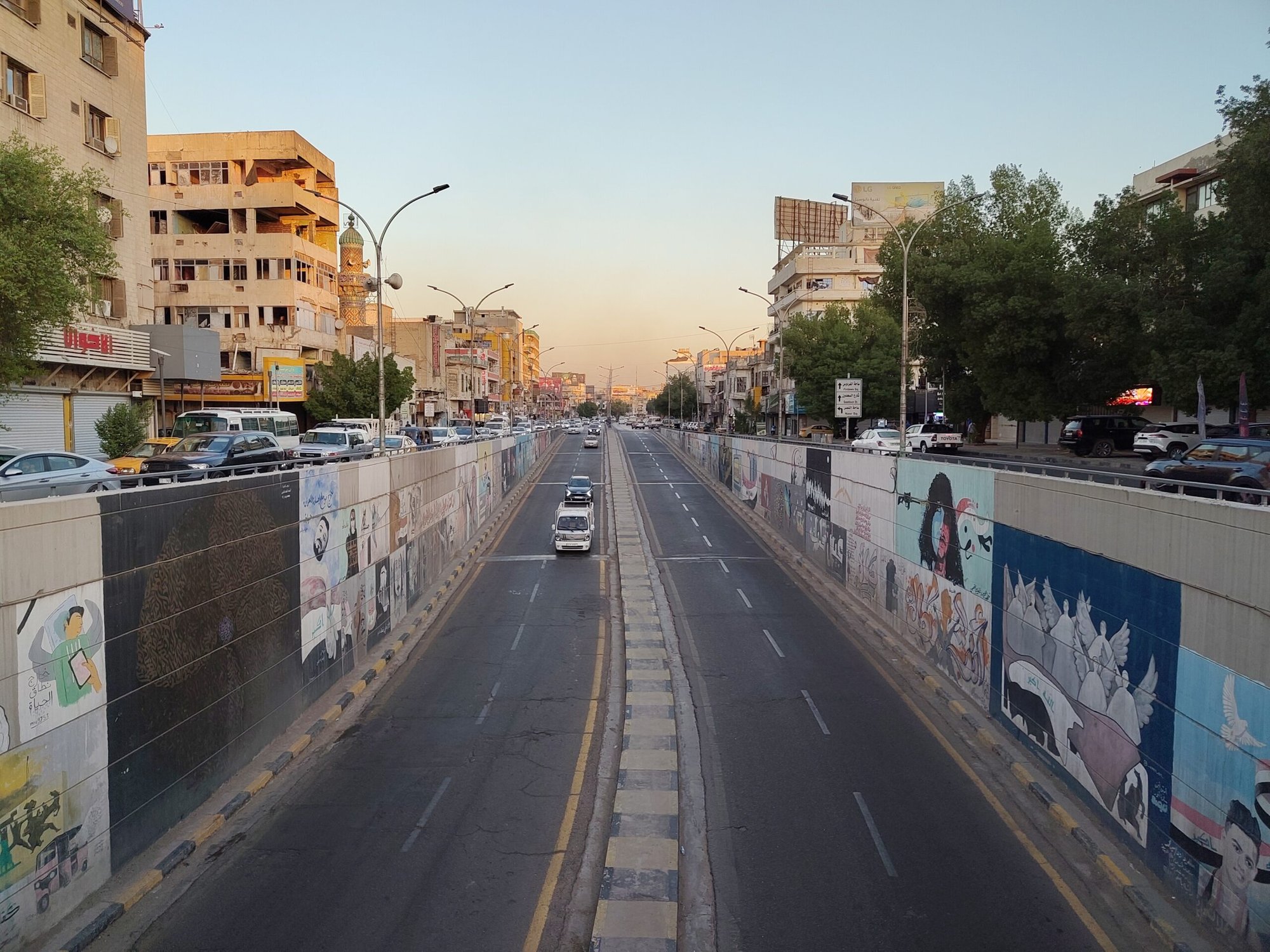
R., a civil-rights activist who requested anonymity for safety reasons, cannot hide his disappointment as we met him in Al-Khulafa street beside Baghdad’s Tahrir Square. Walking along the dozens of graffiti from the thawrat Tishrin, the social uprising millions of Iraqis joined in 2019, R. does not believe in the current government’s efforts and promises to start a “new era” for the country.
Today Iraq looks very different from October 2019. The first signs of this change are visible at Baghdad airport, where political symbols offer a glimpse of the power dynamics at play in the country.
There, pictures of Abu Mahdi Al-Muhandis are everywhere. He was the former vice-president of the Popular Mobilisation Forces (PMF), a largely Iran-backed coalition of paramilitary groups formed in 2014 after a fatwa by the Shiite leader Grand Ayatollah Al-Sistani to fight against the self-proclaimed Islamic State (ISIS). Another major symbolic site is just outside the airport, on the road connecting directly with the capital, where a memorial is dedicated to Al-Muhandis and Qassem Soleimani, the former head of Iran’s Quds Force and, for years, the most important representative of Tehran in Iraq. The site honouring the commanders as martyrs is precisely where the two were killed in January 2020 in a US strike at Baghdad airport.
Once entered Baghdad, the PMF, Iranian, and Shia religious symbols can be seen in almost all streets, giving an amplified picture of Iraq’s reality in the parts of the country where the PMF militias maintain a significant presence. Having contributed to the defeat of ISIS, which disrupted millions of livesacross Iraq and Syria for around three years, the PMF has since 2014 gained a key role in Iraqi politics. Also, they still control several areas militarily, often close to other forces, showing the fragility of a country where the State’s security apparatus, politics, and society are still heavily fragmented. Within such fragmentation, external actors like the US and Iran—the two countries with most influence in Iraqi politics over the past two decades—are fighting for their own space, even more so since the war started last February between the two.
Against this backdrop, seeing the current government establishing a new public holiday in early October named “sovereignty days” represents at least a sharp contrast.
Declared by the current government of Prime Minister Ali Al-Zaidi, a businessman entering politics for the first time, the holiday has been presented as the beginning of a new independent phase for Iraq, far from foreign influence. After months of tense negotiations, Al-Zaidi was appointed last May as a compromise blessed by both Tehran and Washington. The “sovereignty” celebrations followed the departure of the last US military forces on 30 September, ending a continuous presence that began with the 2003 invasion and, during its final 12 years, focused on the fight against ISIS. However, the celebrations also came as Al-Zaidi postponed the disarmament of PMF militias to June 2027. Alongside a spectacular anti-corruption campaign launched in June, soon after taking the office the prime minister had promised that all military groups would be under state control by the end of September this year, apparently underestimating the opposition from the Iran-aligned political parties.
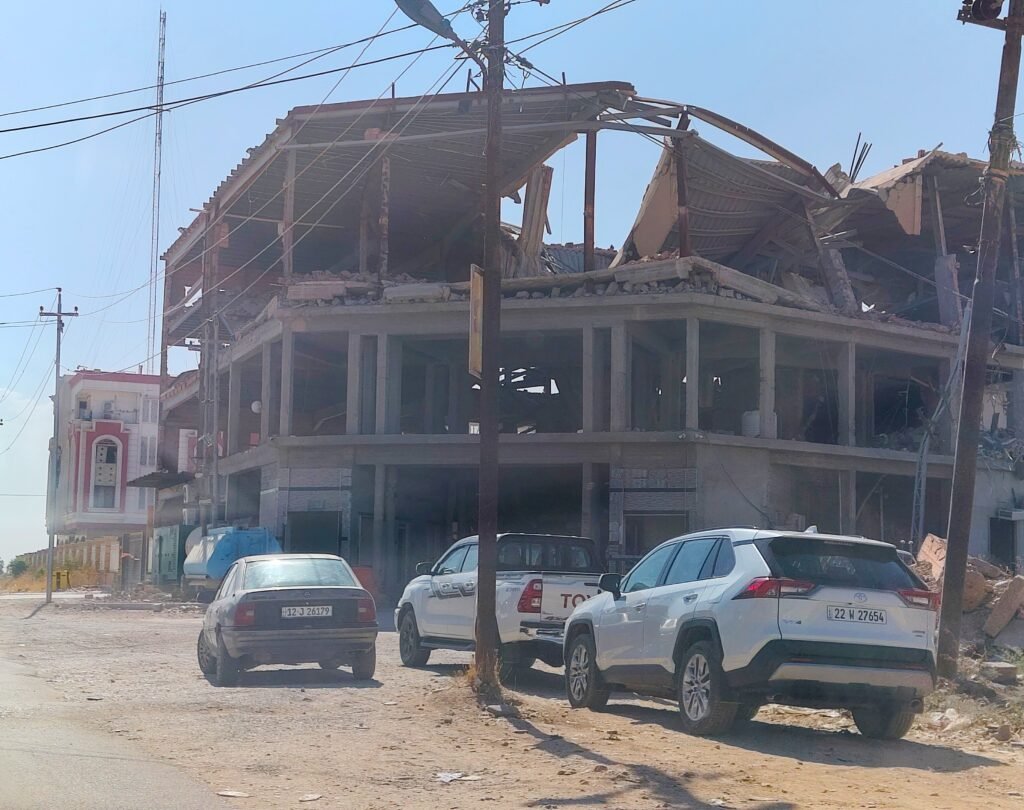
Caught in the middle of the ongoing regional conflict, the military, political and economic consequences of the Iran-US war in Iraq are demonstrating how the sovereignty claim may be more complicated in reality.
Since February 2026, over a thousand drone and missile attacks have hit the country from both sides (1,000 only in the Kurdistan Region, according to official figures), as well as from Iran-affiliated military groups, causing around 150 deaths. At the same time, the crisis around the Strait of Hormuz has severely disrupted the oil sector — Iraq’s main source of revenue — and affected fuel availability and prices. The result is a country that may have reduced Washington’s military presence, but is still exposed to US leverage through other channels. The dollar has been constantly surging against the dinar following the regional war, while US-linked financial channels still remain important to Iraq’s access to dollar liquidity.
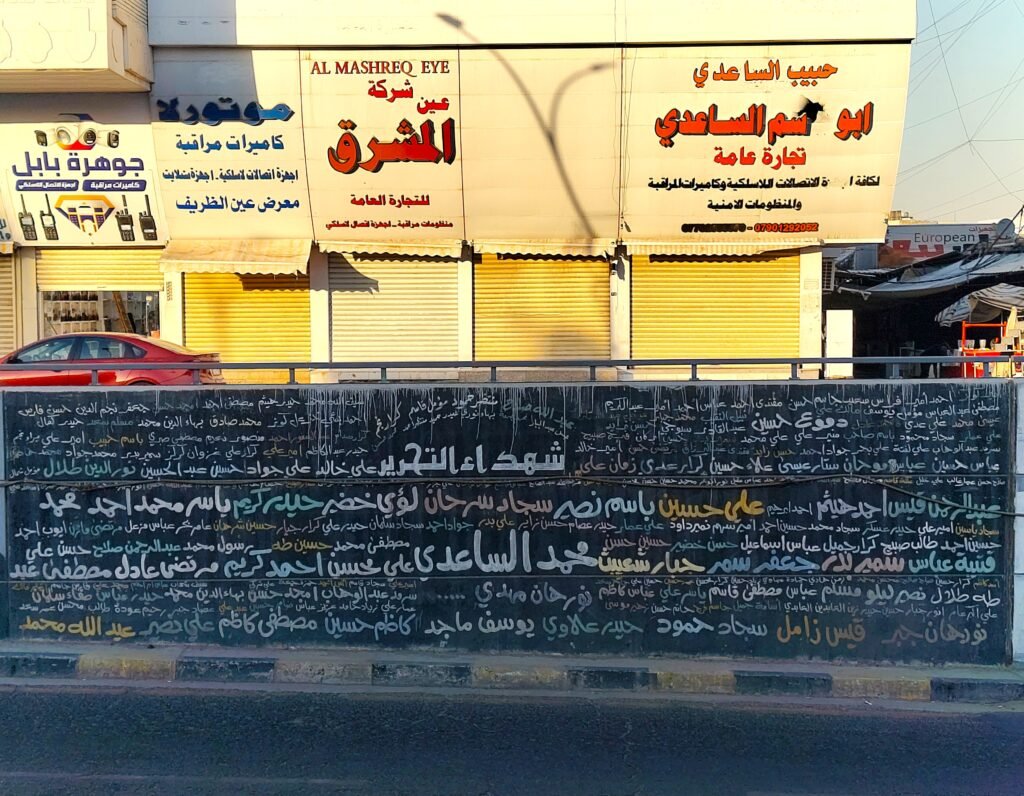
On the other hand, “it’s the militias that instead are stronger now”, tells R., as we move on Al-Khulafa street along the Tishreen graffiti and stop by a black wall named “The martyrs of Tahrir Square.” Compared to the PMF, Shia, and Iranian visual presence in Baghdad, that wall is the only public space devoted to other Iraqi victims, done by the same activists who wanted to change the country seven years ago.
“These are the names of our martyrs, but they should be many more, if we would know the fate of the kidnapped and disappeared,” R. says, pointing that only some of the hundreds of activists are listed. “We had to put dots, under the title, as the deaths kept increasing”.
What was Tishreen?
In October 2019, following years of sectarian conflicts after the 2003 US invasion—including the emergence of ISIS—a broad protest movement demanding systemic reform seized international headlines with rallies, marches, encampments, and civil disobedience actions. Chanting nurid watan (“we want a nation”), protesters demanded an end to foreign interference and the sectarian political system, calling the movement Tishreen, Arabic for “October”. Young people gathered initially in Baghdad’s Tahrir Square and Nasiriyah’s Habboubi Square, to then spread across the main cities of the centre and south areas of the country. Despite the movement’s largely peaceful, inclusive and organised character, security forces responded with what several human-rights organisations described as “excessive and unnecessary lethal force.” Most of that force came from militias belonging to the PMF.
“They were the ones shooting at us, and those are the same militias who have more power than ever today”, R. makes clear.
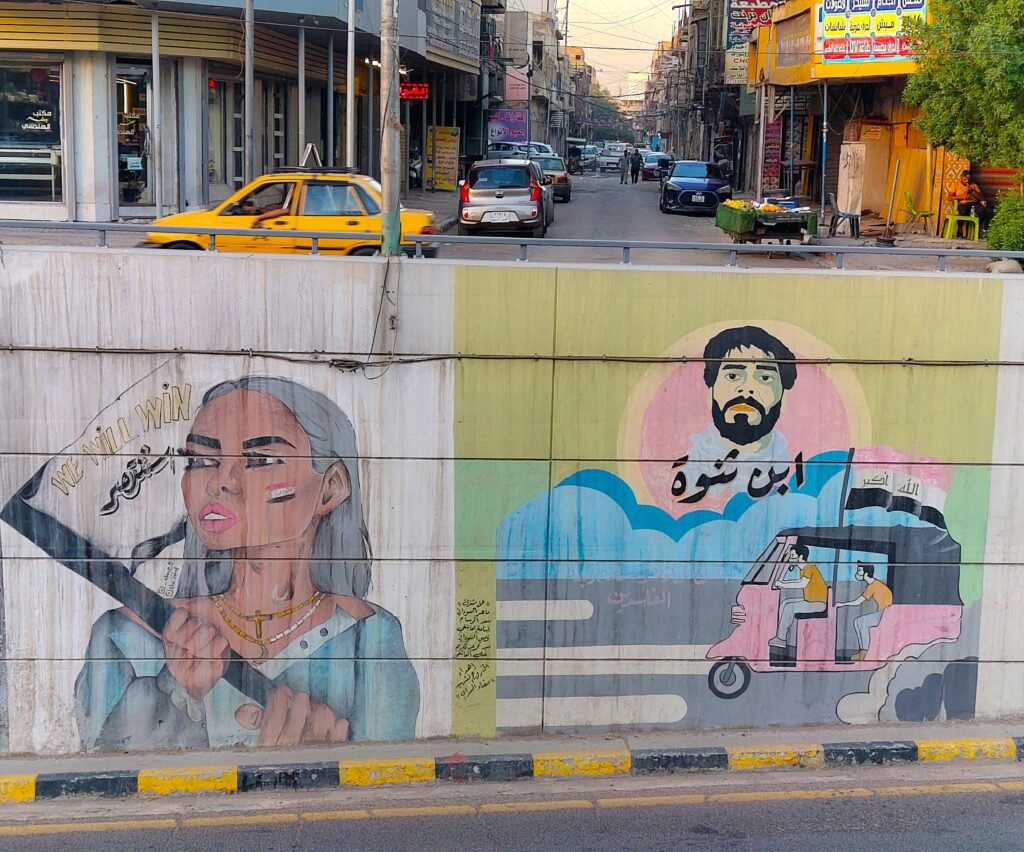
Yet the graffiti street also records what Tishreen represented at its best. As the protests continued for months, they forced the resignation of the government of the time. In Baghdad, at their height, protesters occupied Tahrir Square through an extraordinary range of self-organised activities. Volunteers provided food, water, internet, and laundry services; businesses donated money and supplies; Iraqis living abroad travelled to Baghdad to share, even briefly, the “Tahrir spirit.”
“Mostly in a spontaneous way, at the peak of public anger, in the squares you started to see a profound sense of awareness. Tahrir became a huge theatre of freedom of speech in different forms, like we’ve never seen before,” says Nizar, identifying himself as a protester who took part in different waves of demonstrations since 2008.
“Tishreen fostered unprecedented unity, breaking down traditional social barriers. Doctors, typically insulated by wealth and social class, mixed directly with Tuk Tuk drivers [who were crucial in transporting the wounded, often driving for free, ed], treating each other as equals and sharing the risks and emotional intensity of the protests.”
For Nizar, this unity and a powerful sense of national identity transcended the sectarian divisions affecting the country. The movement opposed corruption, foreign influence and, overall, the muhasasa system. Introduced after 2003 to distribute government representation among ethnic and religious groups, the muhasasa became shorthand for the patronage networks and collusion that allowed political actors to accumulate wealth and influence while much of the oil-rich population faced economic hardship.
“Basically, from one dictator until 2003, this system enabled 10,000 ‘Saddams’,” Nizar says. “No other movement in the past took such a clear stand against the US, Iran, Saudi Arabia, Turkey and all foreign powers who fuel the sectarian system. I believe that Iraqis and the world have still not fully understood the significance of what Tishreen has been. We need more sociological research, because what we did was huge at all levels.”
All this came, however, at a huge human cost.
Repression and impunity
Precise numbers of those killed during Tishreen remain difficult to establish. Activists interviewed by Turning Point put the toll at more than 700, while stressing that the deeper problem is the absence of transparency, justice and accountability.
“Until today, there has been simply no justice process for the numerous disappeared, kidnapped, and killed protestors [from Tishreen],” says Nizar. “How can we expect that a guilty system will punish itself?”
Accordingly, legal accountability efforts have remained woefully inadequate. Last year, Amnesty International reported that more than 500 families whose relatives were killed for participating in the protests had received a one-off payment of 10 million Iraqi dinar (US$6,850) from Iraq’s Martyrs Foundation, with most also receiving monthly payments from the National Pension Directorate. Even those payments, however, have involved lengthy bureaucratic procedures, but the larger issue remains justice itself. Obtaining these payments has involved lengthy bureaucratic procedures. Yet the larger question remains one of justice and accountability.
“Families seeking justice for their lost loved ones have been either bought off, threatened into silence, or faced dismissed cases in corrupt courts,” makes clear R. “Since 2019, each single new PM, at the beginning of their term, says that there will be justice, truth. But those, every time, eventually are just words.”
According to Iraq’s High Commission for Human Rights, there have been 7,663 enforced disappearances between 2017 and 2019 alone, with numbers reaching 11,000 if the timeframe considered is expanded to 2017–2022, according to other sources. Within such a scale of the phenomenon, in relation to the Tishreen demonstrations, little or nothing is known about what happened to many protesters.
“The few who dared to seek information independently found death instead,” says R., citing activist Ali Jasib Hatteb, a human-rights defender and lawyer abducted by a militant group in Maysan on October 8, 2019. While his whereabouts remain unknown, his father began a campaign to find him but was assassinated by an unknown gunman in Amarah on March 10, 2021. The family believes the killing was linked to his efforts to find his son.
A few months after the killing of Ali Jasib’s father, with several activists who had already started to flee Iraq when the protests began to fade during the Covid-19 pandemic, the “End Impunity in Iraq” campaign was launched by Iraqis abroad. It sought international attention for the lack of justice for those killed and kidnapped and for the impunity enjoyed by perpetrators. Although the campaign brought some renewed attention to Tishreen’s causes, the movement gradually lost the “momentum.”
“Many who were initially part of the protest movement later entered politics, accepting the corrupt muhasasa system instead of resisting it from the outset”, tells Nizar, referring to former Tishreen members who started forming new political parties to participate in the 2021 general election.
For him, however, what stopped the movement was the fact that the people arrested for the killings or kidnappings of the activists have often been acquitted or released. This happened also in the few cases that reached international headlines, including in the murder of Safaa Al-Saray, regarded as one of Tishreen’s leaders, whose portrait remains on the graffiti walls near Tahrir Square, and Hashem Al-Hashimi.
Al-Hashimi was not an activist but a renowned Iraqi expert on armed groups who advised governments, NGOs, and UN agencies. On July 6, 2020, two unidentified gunmen on a motorcycle shot him outside his home in Baghdad. Under pressure after his killing provoked outrage in Iraq and abroad, the Prime Minister of the time Mustafa Al-Kadhimi promised to bring the perpetrators to justice. A year later the same PM announced that a suspect had been arrested, showing a televised segment in which the latter confessed to shooting Al-Hashimi.
“Already this media show sounded not credible, at that time,” recalls R., referring to the suspect confession on the public TV. “But when he [the former PM, ed] said that the suspect was a member of ‘rogue group’ without naming it, it was clear it was all a farce to cover the [PMF] militias.”
The circumstances of Al-Hashim’s death may reinforce those suspicions. Days before his killing, the scholar had publicly criticised Kataib Hezbollah (KH), one of the leading PMF militias, and was about to publish a research on the monetisation of illegal checkpoints around Baghdad by KH and other militias. In October 2022, the arrested suspect suddenly disappeared and after being sentenced to death in absentia the following year, he suddenly reappeared in Iraq in 2024, when a new ruling—allegedly organised under KH pressure, according to fellow researchers close to Al-Hashimi—declared the previous sentence illegitimate.
“When you know all this, we have to hear today Hadi Al-Amiri saying that the militias did the right thing ‘defending the country against the Tishreen sedition,’” says R., referring to recent remarks by the Badr Organisation leader, one of the political parties with most influence on the PMF. By its own definition, it is a Khomeinist organisation that receives orders and support from the Iranian Pasdaran.
“How can we then believe the current government’s claims of a new Iraq?”
Today’s climate of fear for activists and journalists
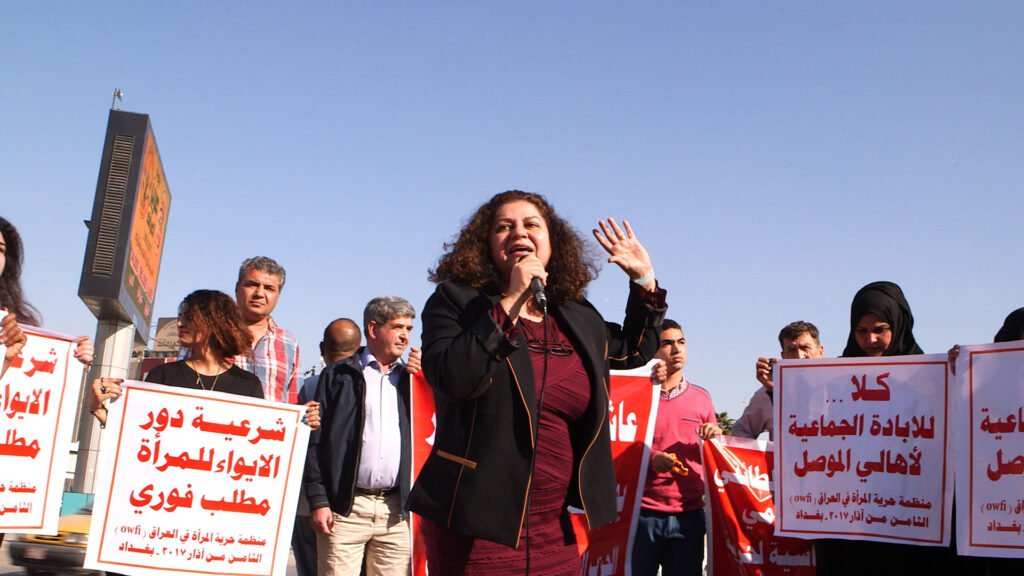
“Fighting corruption and reducing external interference are important goals, but they must be pursued transparently and consistently, not with political slogans,” says Jannat Al-Ghezzi, an experienced Iraqi human-rights activist who has fought for years for a different Iraq. Through her work with the Organization of Women’s Freedom in Iraq (OWFI), Jannat took part in Tishreen and became one of the women publicly associated with the movement.
“For us, Tishreen was not simply a political protest. It represented demands for dignity, reducing external influence, an end to corruption and impunity. But also, justice, accountability, a functioning state and a different relationship between citizens and those who govern them,” she says. “Seven years later, many of those demands are unresolved, and today the situation of civil rights, freedoms and social justice in Iraq remains deeply concerning.”
Jannat understood the risks even more clearly on March 2 last year, when her friend and OWFI co-founder Yanar Mohammed was gunned down outside her Baghdad home by two men on motorcycles.
Yanar was a prominent Iraqi women’s-rights activist who opened the country’s first women’s shelters in 2003, eventually building a network across multiple cities that provided refuge for more than 1,300 women fleeing honour killings, domestic violence, and trafficking.
“She was a woman who dedicated her life to challenging structures that denied women freedom, equality and dignity,” recalls Jannat, now OWFI’s president. “Yanar understood the risks, but she refused to accept that women should remain silent or surrender their rights because of fear. She believed that women’s freedom was inseparable from the freedom of society as a whole.”
Despite international condemnation, nobody has been charged so far, and little is known about the investigation. “A killing of this magnitude requires a transparent, credible and accountable process. Truth remains essential for Yanar, for her family, for OWFI and for everyone who believes that attacks against activists cannot simply go unanswered.”
For Jannat, Yanar’s case is part of a much larger pattern of the too many Iraqi citizens that have been killed and kidnapped in the past years, particularly after Tishreen.
“Justice means credible investigations, identifying and prosecuting those responsible, and providing answers about the fate of those who disappeared. Without accountability, there is a serious risk that violence against activists will continue to be seen as something that can happen without meaningful consequences.”
Also seeking the truth as a journalist remains deeply unsafe in today’s Iraq.
According to Reporters Without Borders and the Iraqi Observatory for Human Rights, 2026 marked another grim year for journalists, with media professionals facing kidnapping, arbitrary arrest, physical assault and coverage bans. A few weeks after Yanar Mohammed’s killing, independent American journalist Shelly Kittleson was kidnapped in Baghdad by gunmen in civilian clothing and later released on April 7 as part of an exchange deal that included members of the KH militia.
“There is no full freedom of the press in Iraq,” says S., an Iraqi journalist who also requested anonymity. “Because we reveal the truth or cover sensitive topics, many of my colleagues continue to be killed, imprisoned, or forced to leave home. I, too, faced many threats because of my work and had to leave home many times.”
Jannat and other OWFI members are likewise living under strict security measures since Yanar’s killing. “We now have to think much more carefully about movement, communication and the protection of the people around us. This should not be the case just because we defend women’s freedom and equality.”
Yet she insists that fear cannot dictate their work. “Fear is a natural response to such circumstances, but we cannot allow it to determine everything we do. We have responsibilities, especially to the women we support because they continue to face serious and sometimes deadly threats.”
According to OWFI, femicide and so-called honour killings, intimidation, restrictions on women’s freedoms and violence against women reflect a wider failure to protect women and hold perpetrators accountable. “The problem is not only individual acts of violence. It is also the social and political environment that can normalize such violence or allow it to go unpunished, as we see today clearly.”
But Iraqi women, Jannat insists, must continue to organise, resist and defend one another. “Giving up would mean accepting that fear and violence have the final word.”
S. thinks similarly about journalism. “I never abandoned my work. From the first moment I decided to be an independent journalist, I knew I began ‘playing with fire,’ but that is also the moment when I feel I am on the right path. My country needs more brave journalism to pursue the truth, whatever the price.”
Jannat echoes him in regard to activists, still very much needed in Iraq to fight for human rights, freedom and social justice.
Despite all challenges and the widespread climate of fear, people in Iraq continue to take the streets. Not only calling for public sector jobs and denouncing unemployment—like it happened in several cities last summer and until September, reflecting the dire economic consequences of the regional war–but also for civil rights.
On October 16, last year, dozens of women demonstrated in Baghdad in protest against the Jaafari Personal Status Code—an amendment to the Personal Status Law of Iraq made in 2025. This amendment created a separate legal framework that citizens can opt to follow, which permits religious jurisdiction over personal matters pertaining to marriage, divorce, custody, and finances. All this, activists argue, pose even more challenges for women in their fight for preserving their rights.
This, for Jannat, honours those who have already paid that price because they decided to speak publicly and collectively. “Yanar’s death, like the killing and kidnapping of Tishreen activists, has left a profound absence. But their ideas, courage and determination continue to inspire.”
Eventually, she says, if there is one thing Tishreen has done, it is to show “the strength of Iraqi citizens, particularly young people and women, when they decide to speak publicly and collectively.”
“What remains of it [Tishreen] is therefore not only what happened in the squares. It is the people, ideas and determination that emerged from it.”
Stefano Nanni
Stefano Nanni is an Italian journalist and writer who lived several years between Iraq, Lebanon, Jordan and Palestine. He writes for international and Italian media outlets and is co-author and translator of several publications about politics, culture and society of the South West Asia region. In 2026, his first book (in Italian) is out, “Da Baghdad a Roma”, the story of the Iraqi poet Latif Al-Saadi.