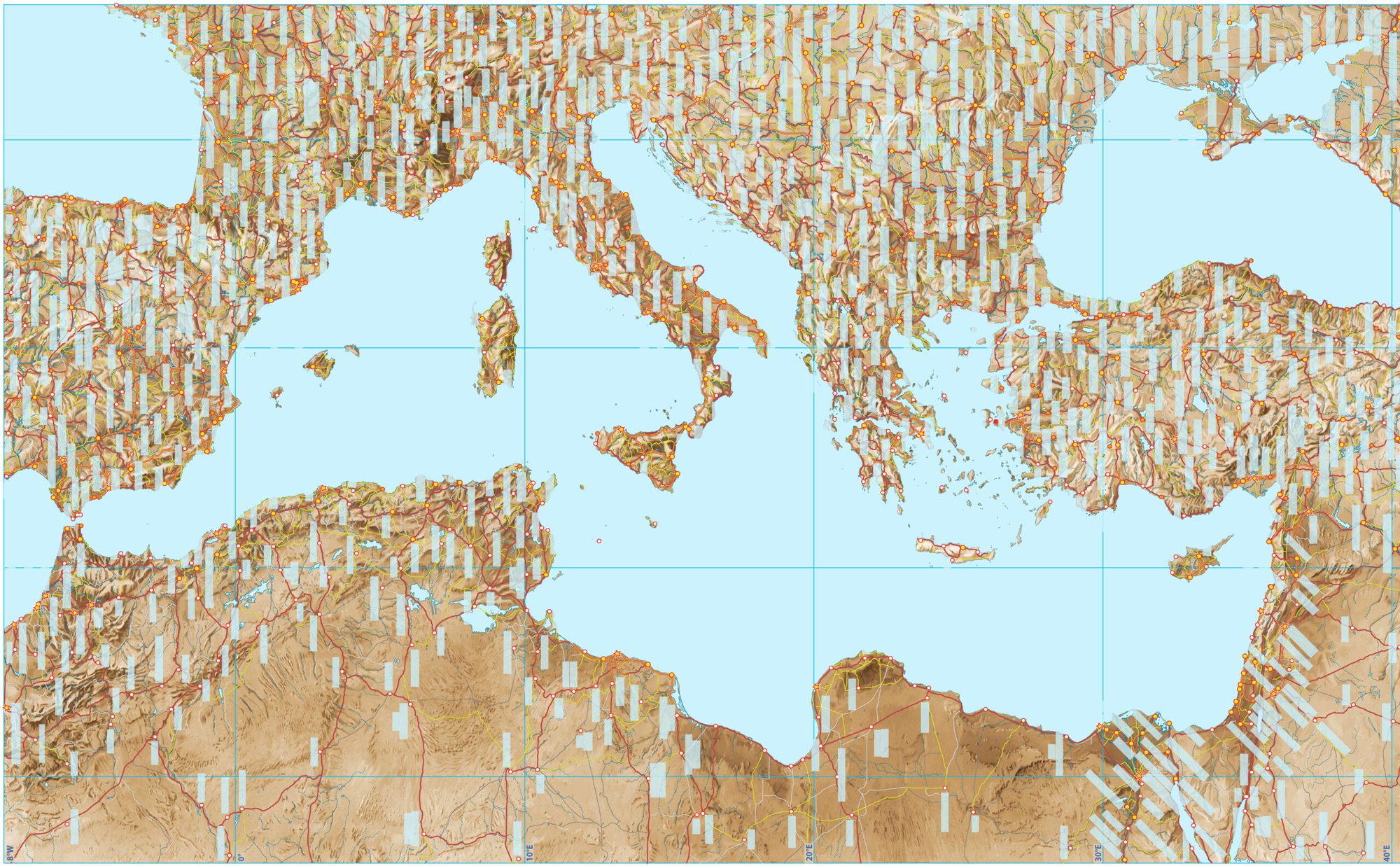



There are no maps of the Mediterranean. Or rather, there are almost exclusively nautical charts. In geography and history books, its three shores are always described in isolation. Yet, at the dawn of the sixteenth century—at the height of a “clash of civilizations”—the Ottoman Sultans’ obsession with cartography filled the rooms of the Topkapi Palace with maps. The most famous were drafted by Piri Reis, a privateer and cartographer, and cousin to Admiral Kamal Ali. It was during a boarding action off the coast of Valencia in August 1501 that the Turks discovered maps of the New World on a sailor who had navigated with Columbus. Following this, Piri Reis began compiling the Kitab-i Bahriye—the “Book of the Sea”—the most celebrated portolano of all time. It was a quantum leap in cartography, which had evolved little since the days of Ptolemy. The Book of the Sea was a treasure trove of data, ranging from the location of freshwater springs to architectural details, and from the customs of coastal populations to their religious practices.
Levantine tradition dictated that sailing occurred only between St. George’s Day on May 5 and St. Demetrius’ Day on October 26. Winter was the season for either building peace or arming for war. That Mediterranean was a cosmopolitan, “mixed-race” world. Merchants, fishermen, slaves, pirates, soldiers, and pilgrims understood one another through Sabir, the lingua franca of the ports and the ships. Pirates—a word derived from the noun peiratés and the verb peiràomai, meaning “to try” or “to make an attempt”—dominated the Thalassa, the sea as an event. This was never truer than during the great events of the era, such as the Jubilee of 1550. For pirates, the Jubilee meant high-ranking prelates and pilgrims en route to Rome would be easy prey for hefty ransoms. For many, the only real chance to assault destiny or seize control of one’s own life, resided on the waves.
Andrea Doria, the most famous sailor of that century of conflict, reportedly left a formidable description of his world: “The Mediterranean has three safe harbors: Lampedusa, June, and July.” This meant that Lampedusa was the only free port; all other safety was found only in the calm of summer navigation. Lampedusa was not merely a neutral zone; inside the island’s caves, one could find symbols of both Christianity and Islam. It was the only place where combat was explicitly forbidden.
The Ottomans, having arrived in Constantinople from the steppes of Anatolia, had only one word for all waters, both salt and fresh: deniz. Despite their initial lack of maritime experience, they quickly mastered the sea. They invented, perfected, or stole instruments like the astrolabe, the alidade, and the sextant. Even today, our maritime vocabulary reveals this history. Azimuth is an Arabic word from the root sumt, meaning path or way. The Arsenal, the pride of Venice, and the Darsena, the heart of Genoa, are Arabic words. The tar used to coat hulls was an Arabic introduction, and the head of the navy was the Admiral.
In that same century, tens of thousands of Europeans went to fight for the Ottomans alongside the “unsheathed swords of Islam.” Almost no one made the journey in reverse. Great historians, from Fernand Braudel onward, recount how some of the greatest defeats of Charles V’s empire—such as the disaster at Algiers in 1541—were orchestrated by the Taif Rais: councils of commanders hailing from Corsica, Sardinia, Calabria, Sicily, the Greek islands, Spain, and Dalmatia. Men chose this path for many reasons: greater social mobility and career prospects at sea, tolerance toward Jews and homosexuals, and escape from the Inquisition or the “galley sentence”—the forced labor at the oars that was spreading across the Christian world starting from Italy.
This was a world steeped in superstition. The summer passage of Halley’s Comet spread despair and prompted penitential fasting among Christians, as its shape in the sky resembled a drawn Ottoman scimitar. These were the final decades in which the Mediterranean basin would serve as the main stage for “Western” history. Between 1497 and 1574, there were no fewer than 3,200 recorded acts of war, including boardings, sieges, and naval battles. Yet, tucked into the folds of this violence is the reconstruction of the Mediterranean as a place of intense exchange, governed by unwritten rules of coexistence at points of intersection like the Strait of Sicily.
It was also a history of massive human movement and staggering loss. In 1537 alone, 20,000 Turkish soldiers marched from Constantinople to support the siege of Corfu, while 30,000 men were deployed to take Castelnuovo in Montenegro, over half of whom never returned. In 1541, 8,000 Christians died in the failed siege of Algiers, where a captured soldier could be bought at the slave market for the price of an onion. The scale of death continued through the winter of 1543, with 30,000 Turks camped in Toulon, and into 1544, when Admiral Barbarossa captured 15,000 Italians, 8,000 of whom died in the holds and were cast overboard. Tens of thousands more would perish at Djerba, Malta, Lepanto, and Tunis.
It was a completely useless slaughter. If we compare the maps of 1497 to those of 1575, the territories that changed hands were few and largely insignificant. The great difference today is that power over the sea was once contested; today, in an era of one-way migration, the overwhelming power sits entirely on the Northern shore. The sixteenth-century Mediterranean established three fault lines that define our modern fractures. The first is the death of Sabir, which signals the end of a “hybrid” Mediterranean—a world that, even in war, built spaces for relationships between members of different cultures. The second is the function of Lampedusa, once a sanctuary of shared faith, now the “tomb of our civilization” and a symbol of failure to welcome. The third is the legacy of the “foreign fighters.” The Ottoman fleet was commanded not by Turks, but by a Serb, a Greek, a Bosnian, a Croat, and Italians such as Scipione Cicala of Messina. This gaze upon the Mediterranean—once a place of conflict but also of caravans and cross-pollination—reminds us of a fundamental shift. After the fall of Algiers in 1830, the winners stopped taking prisoners, and the two shores of the Mediterranean would never be equal again.
There is no way to look at Lampedusa through a modern lens, it existed as a part of a world of trade languages and truly seafaring peoples that we can’t even envision today. It can’t be held up as progressive project or liberation movement that was swept away with the shifting borders of empires. The city existed as part of the same mercantile world that gave rise to mass enslavement and colonization. Nonetheless, its mere existence outside the full power of state or religious authorities who shaped the era stands in opposition to many incorrect assumptions about the era that remain pervasive till this day and affect how European nations treat the people who share the shores of the Mediterranean.
Federico De Ambrosis
Federico De Ambrosis, a computer scientist by profession, has used his knowledge to digitize piracy incidents in the Mediterranean in the sixteenth century. He is the author of Il sabir dei pirati (The Pirates’ Saber). He works in machine learning and is the founder of the Nina collective, which fights for a more democratic AI.