


When a quadcopter’s buzz cuts through the August night above Athens’s Prosfygika housing block, it does not raise eyebrows anymore. In front of the neighborhood’s community-run kiosk, word of the unwelcome surveillance drone spreads from table to table as residents go on socializing, playing backgammon, and welcoming outside supporters. Within minutes, a silent alert ripples through the block in a routine display of collective vigilance that underpins the warm, relaxed atmosphere.
“Is it usual for police to fly drones over here?” asks a housing activist, who has just crossed half of Europe to support the local community.
“It’s pretty normal,” one resident replies, pointing to a 58-meter-tall brutalist concrete fortress rising above the rest of the neighborhood. “The regional police headquarters is only a hundred meters away.”
“No, it is not normal,” another person cuts in from a neighboring table. “We shouldn’t normalize these things!”
Surveillance flights, all soon agree, have become a daily fixture only due to Greek authorities’ campaign to “provoke” residents who oppose a state-backed redevelopment plan for the historic housing block. Estimated at €15 million, the project has become a central focus for the New Democracy party, which rose to power in 2019 with a hardline program against informal housing, migration, and “left radicalism.” With national election campaigning set to kick off again in September, the government has recently framed Prosfygika as “one of the biggest pathologies in Greece” and a litmus test of its iron-fist stance.
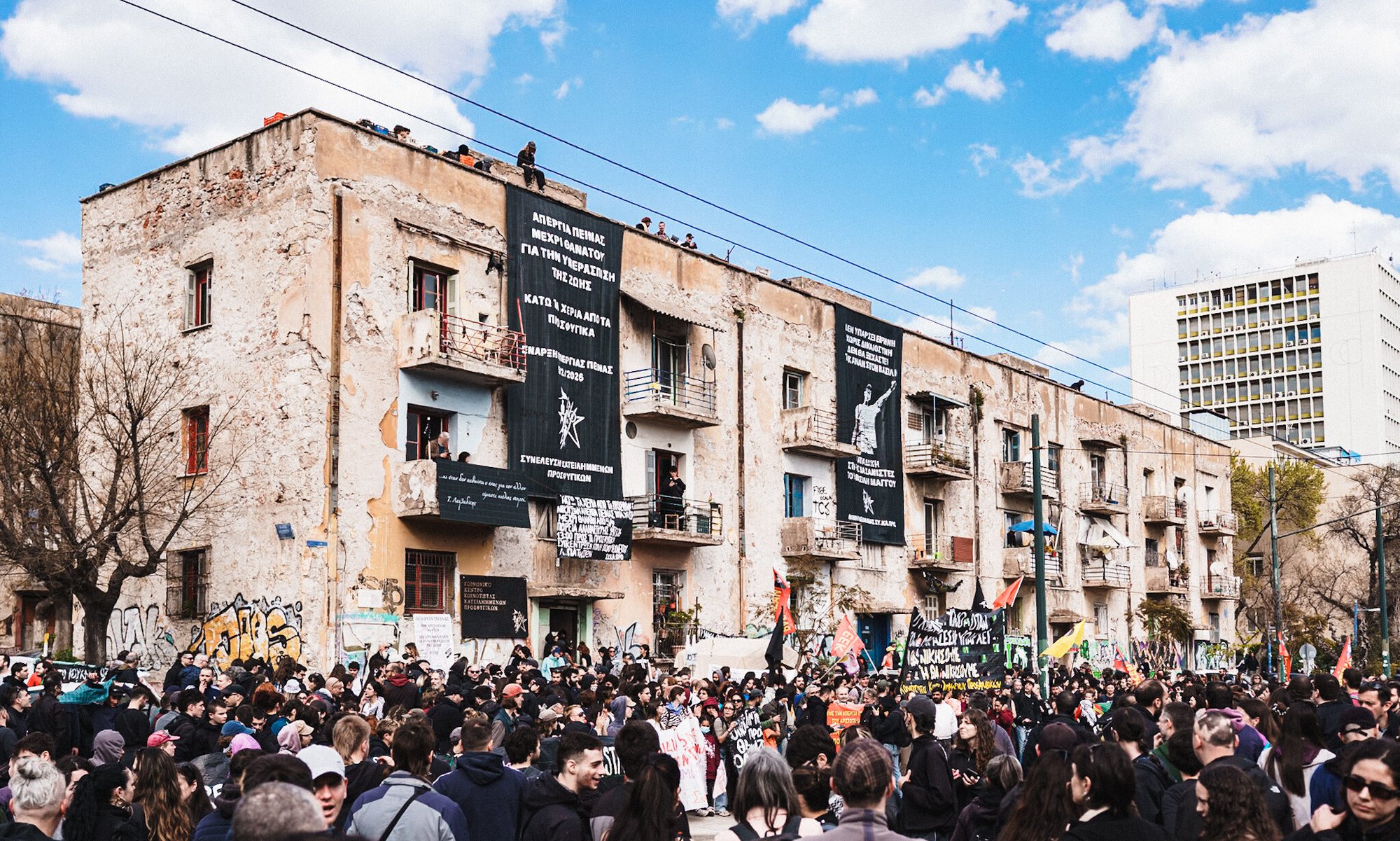
After decades of institutional neglect, the 90-year-old complex of eight blockhouses has turned into the largest self-governed living space in Europe. Today, the Community of Occupied Prosfygika houses more than 400 people—drawn largely from working-class families, migrants, youth, and others excluded by the predatory rental market of Europe’s third least affordable capital.
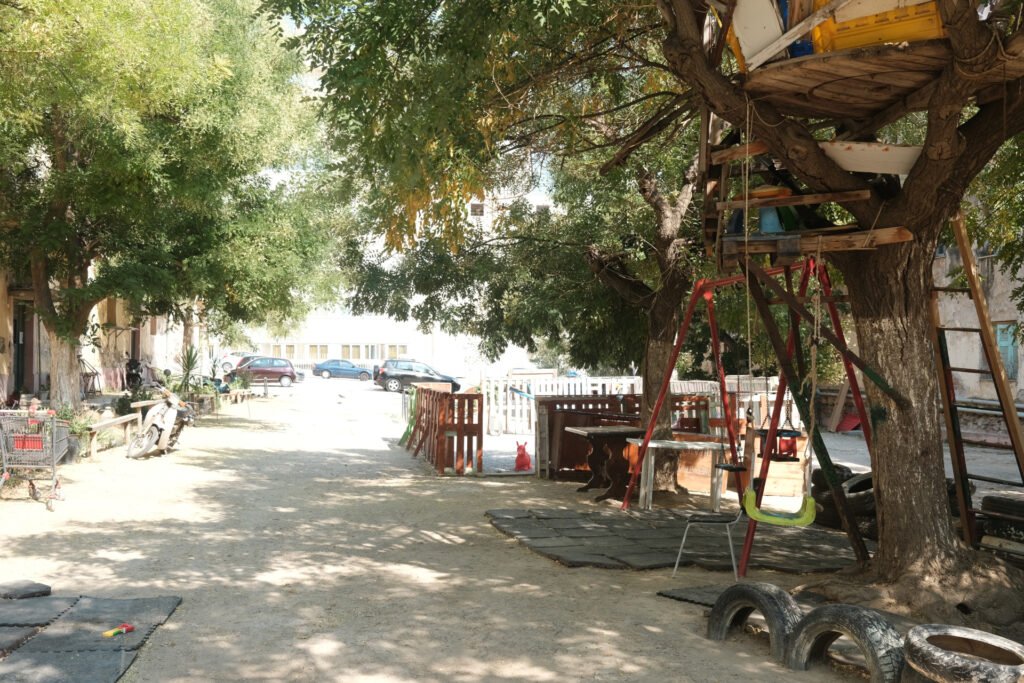
Hailing from 27 different countries and diverse political and social backgrounds, the residents have run the neighborhood with a horizontal system of communal ownership and direct democracy that draws inspiration from self-governance movements across the globe, including in Chiapas and Kurdistan. The hybrid model, they insist, has already been working on the ground for 16 years, with 23 self-organized welfare structures—including a communal bakery, library, children’s daycare, and free internet—serving the block and the surrounding Ampelokipoi district.
For the Community, the state-backed commercial overhaul does not represent urban renewal, but an existential threat that would rip apart the neighborhood’s collective fabric and soul. While Greek officials pitch the initiative as a social housing project, the residents denounce it as a propaganda cover for displacing its existing population. Noting that state-provided social housing is virtually non-existent in Greece, they say the project would only “extinguish” the neighborhood’s autonomy and open gates for militarized gentrification already creeping through the neighboring Exarcheia district.
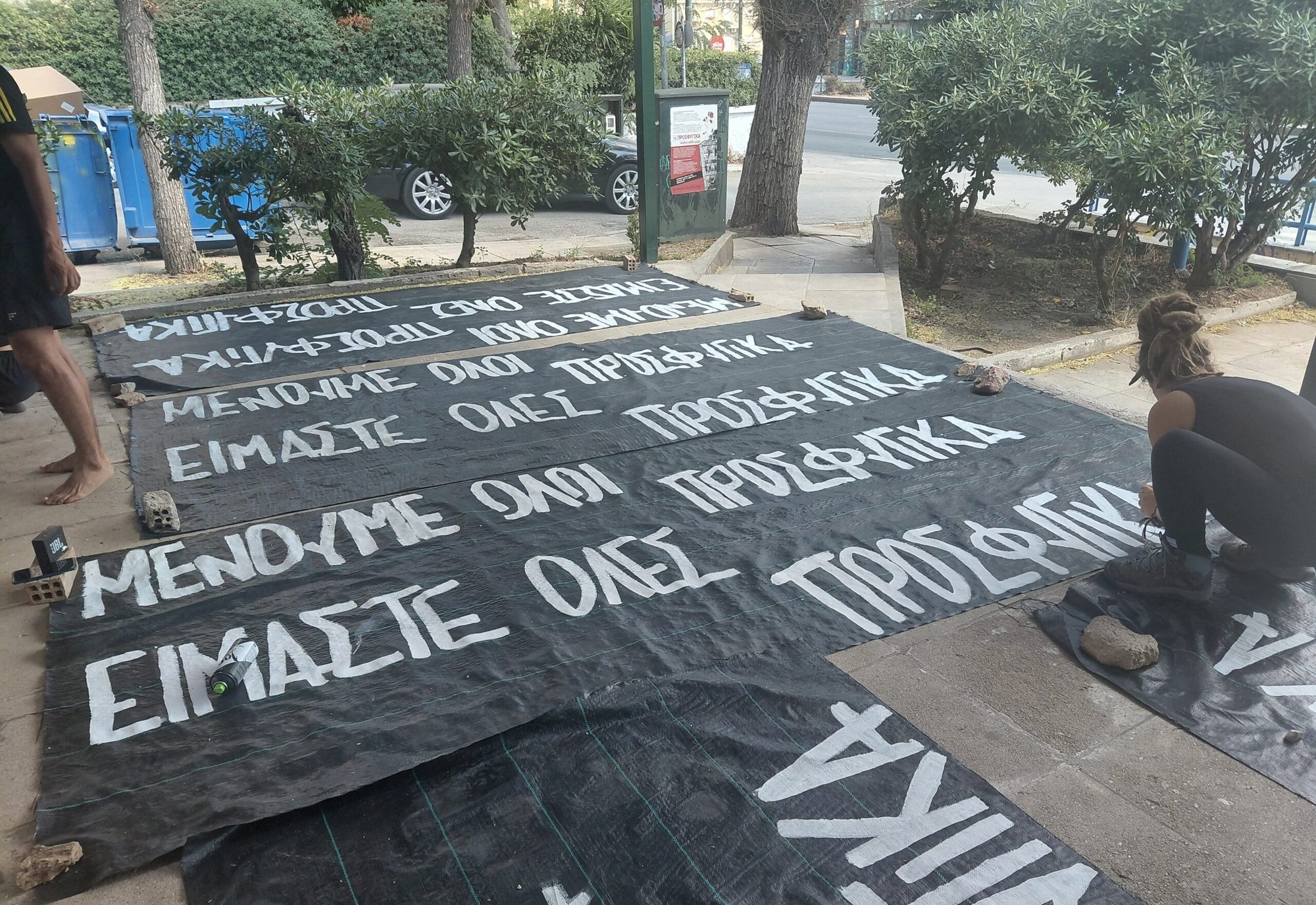
Following the Community’s call for international mobilization in August, the conflict on Alexandras Avenue has rapidly outgrown its local geography as supporters from across borders converged in the neighborhood to turn its recent victories into a new toolkit to defend self-governing spaces worldwide.
A Community Forged in Resistance
In the shadow of the Greek Supreme Court and the regional police headquarters, the eight low-rise buildings of Prosfygika stand out as an anomaly against the surrounding architecture of power along Alexandras Avenue. Its crumbling walls and tree-covered courtyards nurture the side of Athenian history that refuses to turn into tourist sites, while towering white letters across the roofline of its fifth block send a defiant message across the neighborhood: “Resistance is Life.”
In a form or another, resistance has always marked life in the Bauhaus-inspired complex that was declared a protected cultural heritage site in 2009. Built in the 1930s for Anatolian Greek refugees fleeing the massacres and forced expulsions of minorities that laid the foundations for the modern republic of Turkey, Prosfygika—literally “refugee houses”—was etched from its inception with the memory of displacement and a struggle for dignified life.
The bullet and mortar wounds from the December 1944 are still visible in the block’s plaster facades—scars left behind when ELAS partisans fought British-backed conservative forces across its courtyards in the Battle for Athens. The community survived the 1967 military junta, which wanted to flatten the complex for a courthouse, and decades of liberal and social democratic governments eyeing the site for a new shopping mall. While each passing era and governing ideology had its own vision for the neighborhood, only the residents’ refusal to be erased endured the test of time.
The Community of Occupied Prosfygika articulates itself as the latest ring in this inter-generational and international chain that “keeps alive the spark of a life outside of barbarity, aiming for equality and humanity.”
When a small group of squatters set out to form the Community in 2010, state pressure had already driven out most homeowners during the failed campaign to build a shopping mall. Foreign creditors had taken control of the Greek economy, and neglected neighborhoods like Prosfygika had fallen into the reign of organized crime. Reclaiming the territory from the mafia—who allegedly operated with the blessing of the nearby police station—became the Community’s foundational battle to restore life in the neighborhood.
“We understood that to survive, we would have to unite and organize collectively,” the Community writes in its historiography, positioning its origins in the wider wave of anti-authoritarian mobilizations that swept Greece at the time. “We envisioned a community where people live together, where the homes are shared—not owned—where decisions are made collectively, where members support each other and fight together for our lives.”
Venetia, an Athenian woman who got involved in the Community through volunteering at its bakery and healthcare clinic, said it was this culture of solidarity and autonomy that made her eventually move in permanently. She illustrated the the community’s growth through its Women’s Structure, in which she is currently one of the responsibles.
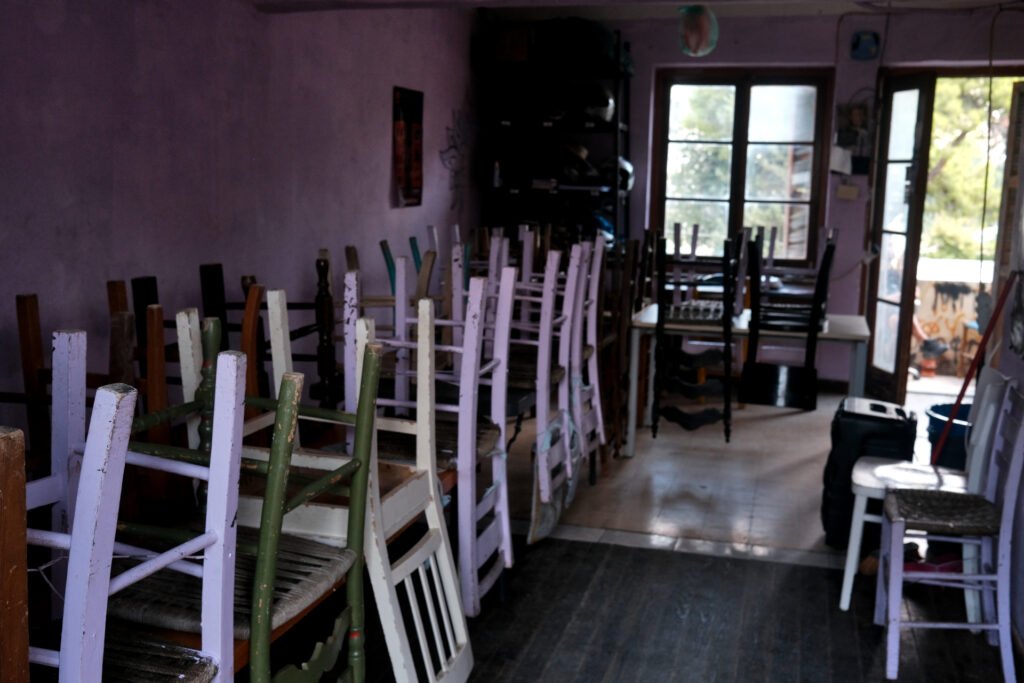
“It started with women meeting for coffee to discuss daily needs, like food, childcare, and healthcare access,” she explained, saying that the group turned into a formal structure only over time with women “collectivizing” their shared experiences.
The structure now runs its own social space, manages a guest house for women visitors, and organizes a range of other social and cultural programs. At the same time, it became a driving force for the community’s political development, forging a whole new system of transformative justice to confront social and patriarchal problems with collective critiques and mediation processes.
“This structure allowed women and femininities to organize collectively and reinforce the community,” Venetia said. “Taking the main responsibility of a culture [of] how we can develop comradeship relationships that was adopted by the entire community.”
Since 2021, the Community has recognized the women’s structure as its core pillar and the only organ outside the General Assembly that can autonomously decide on various matters in the neighborhood. All the other 22 communal structures created throughout the years remain strictly accountable to the General Assembly—an open assembly of all community members convening every Monday to set a collective direction for the community and its working groups.
Yet, the basic principle remains always the same: with a large degree of autonomy defined by the assembly, each structure serves the neighborhood and the surrounding district, while adding its distinct political dimension to the community: the bakery and canteen turned cooking into a collective tool for survival; children’s daycare and health structures politicized reproductive labor; and the gardening structure—one of the newest additions—is already reshaping the neighborhood’s relationship to rural collectives and communities.
Venetia compared this network of assemblies, working groups, and structures to a human body, saying it is “always changing and developing.” Moreover, she said, this hands-on experience of self-organization was key to the community’s resilience when it took the state-led redevelopment plan into a frontal fight this year.
The Threat of Erasure and “Social Self-Defense”
Prosfygika’s latest “cycle of struggle” started in November 2025, when the Region of Attica announced a €15 million EU-funded plan to convert the housing complex into social housing units and a hostel for patients at the nearby Agios Savas oncology hospital. The historic buildings were uninhabited, government spokespeople said, and therefore well suited for the purpose.
For the Community, the announcement was an existential blow. It not only threatened the homes, health, and livelihoods of all its members—including 50 children—but erased its very existence from the official narrative. The same methods that had secured the neighborhood’s autonomy against incursions by drug dealers, neo-Nazis, and the police would not work against real estate developers with the whole government backing their plan, pushing the community to critically reassess its tools and strategies.
“This is the part where the state underestimated the community because they know the usual patterns of how squats defend themselves,” said Younes, a German No Borders activist for whom Prosfygika has become a “second home” during his long stays in Greece for refugee support work. He explained how the community didn’t just prepare for an eviction but started a “counter-attack” of its own.
Partnering with the healthcare workers’ union, the residents transformed a 55-square-meter apartment into a free guesthouse for patients at Agios Savas hospital. They launched a window restoration campaign across all eight buildings and are now gearing up to renovate the buildings’ original plaster facades. In practical terms, the Community started undermining the very basis of the state-led project by proving it was already providing everything listed in the €15 million plan.
In response to the eviction threat, Younes began working at the Community’s Internationalist Committee—at the time a newly-established committee formed upon the need to further promote and organize international solidarity between Prosfygika and other realities. He highlighted that practical solidarity and collective solutions are not just survival tactics, but the natural heartbeat of the community.
“Everything starts from basic needs and everyday problems,” he said, referring to the campaign and all other structures in the neighborhood. “Through this, relations are built, a political stance is built, a perspective is built concretely—a perspective you can hold in your hand because it is physically lived.”
Nori, a permanent resident who now coordinates the internationalist committee with Younes, further explained the Community does not confine itself to ideological “stamps,” but builds an open political stance with terms such as autonomy, solidarity, and self-organization that guide daily life in practice.
“[Prosfygika] is about imagining a society without oppressing each other: how we build relationships with others, how we answer to our needs and organize around them, how we defend ourselves, and what we build in reality,” Nori said. “It is an organization built by all kinds of people—children, babies, very old people, people from many countries, backgrounds, and ideologies.”
While the Community calls this ability to develop solidarity-based networks and broad social responses to potential threats its “social self-defense” and most fundamental protection, Nori and Younes said that the current eviction threat has pushed this strategy into an entirely new phase.
Six Months of Struggle
“The community decided to activate self-defense on all levels,” Nori explained, recalling crowded neighborhood assemblies stretching through the winter evenings. “The strategy had three intertwined layers: social, legal, and militant… Together, they created a plan.”
Residents’ legal struggle had already spared the complex from demolition in the 2000s by securing cultural heritage status for the site in two consecutive rulings in 2003 and 2009. This time, however, the campaign aimed to protect something even more vital: the social fabric housed within the historic architecture.
In July, the legal strategy achieved a major breakthrough at the EU level, when a cross-party coalition of MEPs questioned the legality of the Attica Region’s plan. Their inquiries revealed that no European funds had been approved for the project, shattering the government’s claims of building social housing with a €15 million budget from the EU. The EU Commissioner for Cohesion and Reforms further reaffirmed the conditions governing EU funds, emphasizing that the forced displacement of vulnerable populations violates the union’s human rights charter.
But it was ultimately the unyielding pressure at the “militant level” that broke the deadlock over the redevelopment plan.
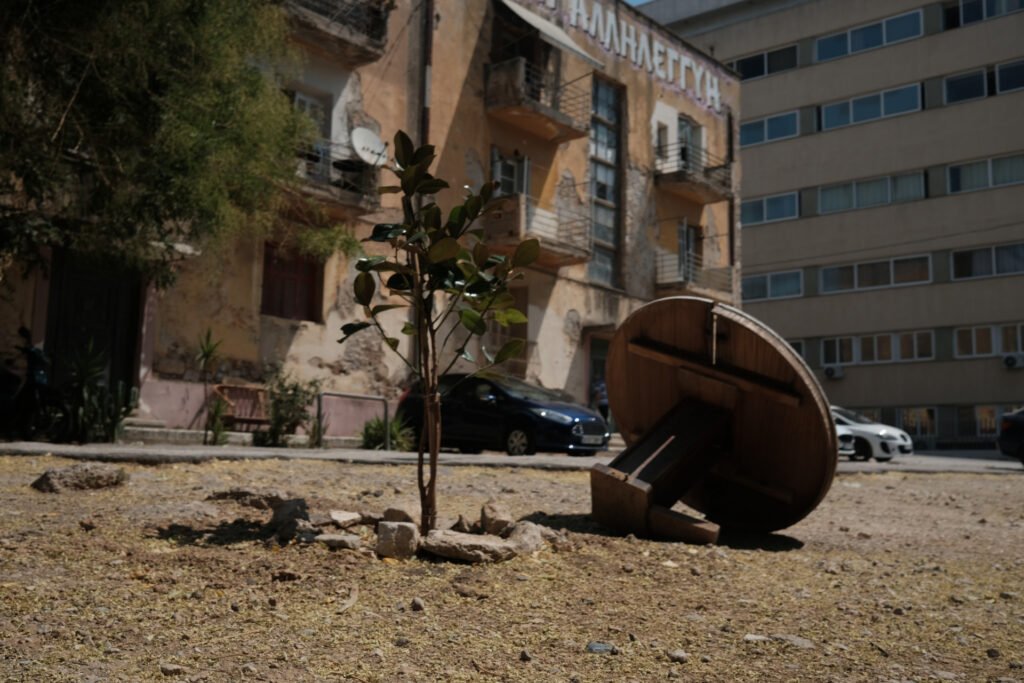
The community’s “six months struggle” commenced in full force only on February 5, when the first resident entered a “long hunger strike to death”—an indefinite vitamin-tea-sugar-salt diet often followed in prisoners’ hunger strikes in Turkey and Kurdistan.
“The method I have chosen allows the striker to go on a long hunger strike, so that there is enough time to communicate the demands to society,” Aristotelis Chanzis, the first resident to volunteer, said upon commencing the action. He declared the Community was ready “to defend our social proposal, the people, the structures, and the historical memory of the Prosfygika to the end.”
All interviewed community members echoed Chanzis’ words, saying that it was a struggle of the whole community rather than an individual action. Venetia said that starting and escalating the hunger strike were “collective decisions for the collective demands of the whole community.”
“The entire community supported them in every possible way, with each person contributing according to their capabilities and making extra effort,” she said, adding that the radical action was launched because the hunger strike was “one of the strongest political tools” the community had.
“Instead of just waiting for an attack and defending against it, we […] used the hunger strike to put pressure on the state and take matters into our own hands,” she explained.
While government officials and media initially ignored the hunger strike, another member of the community, Suzon Doppagne, joined Chanzis on May 1. The municipality of Athens eventually conceded on June 24—the 140th day of the action—after Chanzis was hospitalized two days earlier due to critical neurological symptoms. With more than 5,000 people marching through the city in support of the community’s demands, the municipality decided to withdraw from the plan and call the Attica Region into a dialogue with the residents.
Combined with the revealed lack of EU funding, the crumbling local partnerships practically dismantled the original redevelopment plan, leading the Community to call off the hunger strikes, announce a victory, and assert itself again at the center of the neighborhood’s future.
“The state can no longer deny that this community exists, nor can international institutions ignore us,” Venetia said, calling the outcome a significant win.
She and other residents, however, cautioned that the government’s position toward the Community had not changed: officials merely returned to the earlier “law and order” rhetoric to advance an eviction—only without money or plan for the buildings’ use.
“Every August we are on alert because many people leave the city for holidays, making spaces more vulnerable to state eviction attempts. This August, the alert level is higher following our recent struggle,” Venetia said. “Because of this threat, we issued a call for international and local comrades to come stay and support the community.”
A Future Without Limits
In mid-August, the corridors of Prosfygika were buzzing with an energy that evoked an image of Alexandras Avenue from a century ago when the proletarian district sprawled entirely outside the grid of urban control. Following the Community’s call to defend the neighborhood through the critical month, supporters arrived from across the world in such numbers that new houses had to be opened every week: with daily arrivals and departures, a steady presence of 40 to 50 guests filled each available corner with air mattresses.
While Chanzis remained in intensive care due to severe complications in his recovery phase, the entire neighborhood seemed to embody his steadfast commitment to the continuation of life. Day in and day out, a continuous stream of small teams traversed the courtyards, restoring window frames, renovating houses, and reinforcing barricades. Debates and seminars filled the garden spaces late into the dark, and in the small hours, the neighborhood kiosk ran out of seats each night.
“Even under high repression, we continue to improve the living conditions [and] open up more to the surrounding neighborhood,” said Kai, a German member of the Save Prosfygika campaign who came to the neighborhood already in May. “Our structures—like the bakery, the health structure, and the guest house—serve community members, hospital workers, and local residents alike.”
According to him, the new guesthouse for Agios Savas hospital patients is a big step for opening toward wider society, and the collective experience of going through a hunger strike was a major growth process for the community.
“When you live here continuously, you might not notice every small change, but coming back, the growth of the community is very visible,” he said, adding that the recent influx of outside supporters helped “in many practical ways beyond physical defense.”
According to him and Nori, the show of solidarity and the spiking interest in the Save Prosfygika campaign owe to the consistent groundwork that the Community has done since its inception, “hosting and welcoming internationalists, visiting other grounds of struggle, learning, exchanging, and building relationships.”
“Even during the last six months of intensified struggle, when we could not travel, the perspective remained [the same],” Nori said. “To build a network of communities, organizations, and individuals who find themselves together in a struggle—not only for Prosfygika’s survival, but for the survival of ideas.”
The Community declared an effective end to this chapter of struggle on September 3, when Chanzis returned to the neighborhood following the longest hunger strike in modern Greek history and 73 days in the hospital.
After bringing the hunger strike to a successful conclusion, residents now appear to look at the future with renewed confidence despite government threats to evict the community before the next elections—currently scheduled for Spring 2027.
“This is just the first stage of victory,” Venetia said, refusing to speculate if the government would try a violent mass eviction after the critical summer month. “The struggle continues until we have permanent guarantees that the community will not be evicted, allowing us to proceed with renovating the building facades and securing long-term housing stability for the residents.”
“The future is not limited to this neighborhood. We want to see 1,000 neighborhoods like this,” added Younes. “It will look different everywhere, but the core is the same: people going toward each other, building assemblies, making collective decisions, and realizing them together.”
Editor’s note: Interviewees appear in this article with first names only to protect their personal safety amid ongoing criminalization and surveillance of the Prosfygika community and its support networks.

Henri Sulku
Henri Sulku works as an editor at Turning Point. His reporting focuses on political economy, people’s history, and resistance movements.