


On August 26, late afternoon, a screenshot of a tweet reached the members of Autistici/Inventati (A/I), an Italian tech collective, shattering at once their years-long server maintenance routine. While most of the country was preoccupied with record-breaking heat lingering over the end of summer holidays, that single image cast an inescapable shadow over the group.
“Today, the United States sanctioned several transnational far-left terrorist networks, including Autistici/Inventati,” Marco Rubio, the U.S. Secretary of State, wrote, linking to a Treasury Department press release. The Treasury accused the group of providing technological support for the Iranian regime, violent “Antifa cells,” and other entities conspiring to “destabilize the United States.”
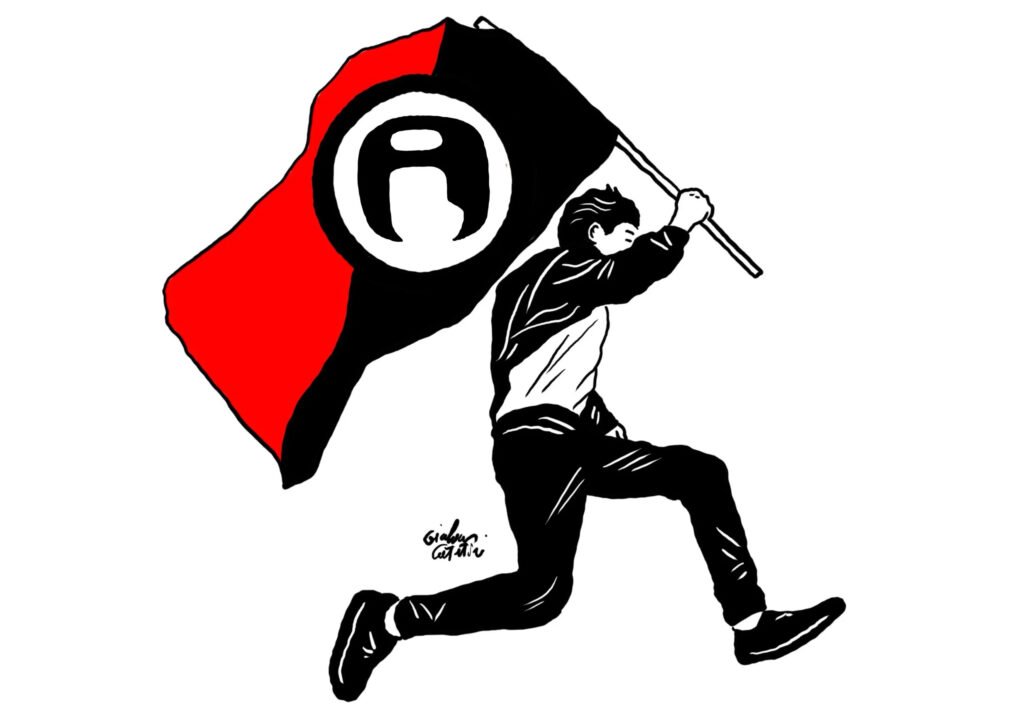
Washington’s sudden interest came as a complete surprise to the small volunteer collective, which hosted free communication and publishing tools for grassroots activists and organizations. Born at the apex of the millennial counter-globalization movement in 2001, the group aimed to turn the movement’s anti-fascist and anti-capitalist ideals into building blocks of an internet outside corporate hands. Over decades, its platforms attracted thousands of users who sought protection against rapidly growing digital surveillance. As of August this year, A/I hosted 16,000 email accounts, 5,500 mailing lists, 1,500 websites, and over 10,000 blogs on its popular noblogs.org platform.
The infrastructure now faced the wrath of the U.S. Office of Foreign Assets Control (OFAC), a little-known Treasury bureau whose powers have expanded dramatically since the 9/11 attacks in 2001. The sanctions enforcement agency has become one of Donald Trump’s signature foreign policy tools, as the White House has fed the office with an increasingly eclectic list of targets, including UN officials, International Criminal Court judges, and a growing roster of European left-wing organizations.
As the news broke, the collective was first in disbelief, then in shock. They immediately called an emergency meeting to analyze the situation and decide what to do. The discussion was heated. Many were still processing the information, and unanswered questions hit the group from all sides: How could it be contested? What does it mean for the collective, its users and members, and everyone they cared for? And why had it happened in the first place? For them, it was as if Google or WhatsApp were labeled terrorists for how someone somewhere had, allegedly, used their services.
No precedent existed for guidance, as no other grassroots digital communications provider had yet been swept into the same sanctions program. No evidence was presented, and no one was charged. No trial. No court of law to appeal to. Describing those early hours, a former volunteer told Turning Point the collective was prepared for “many different attacks,” but it had never crossed their minds to be labeled as terrorists by the U.S.
“We were prepared to resist administratively, legally, technologically, and politically—and we were successful as they never took us down,” he said with a melancholic smile on September 16, speaking on condition of anonymity. “But we were not prepared for an act of war.”
Ten days earlier, A/I had announced its dissolution, effective on September 18. The collective stated it could not continue its 25-year-old mission—“offering secure and non-commercial digital tools”—under the terrorist designation. They would not be safe to use anymore. While the collective’s servers now hum idle, legal experts warn that the story is far from finished, and what happens next may have far-reaching ramifications on both sides of the Atlantic.
The Department of White Collar War
Buried beneath layers of Treasury Department bureaucracy, the Office of Foreign Assets Control has been described as one of the most powerful yet unknown U.S. agencies, orchestrating economic warfare worldwide. Its origins trace back to 1950, when the People’s Republic of China entered the Korean War, prompting the U.S. President Harry S. Truman to resurrect World War I-era statutory powers to freeze every Chinese and North Korean asset under U.S. jurisdiction overnight.
Today, OFAC continues to enforce trade embargoes against conventional U.S. adversaries such as Cuba and Iran, but its mandate has widened dramatically over the past three decades. With a few hundred employees—mainly lawyers and intelligence analysts known as “targeters”—the agency now wields crippling sanctions regimes against a variety of non-state actors, ranging from drug cartels to the UN Special Rapporteur Francesca Albanese.
When Autistici/Inventati’s name appeared on the office’s list of Specially Designated Global Terrorists (SDGT), the consequences were immediately felt across the Atlantic. The collective’s PayPal account was erased the following day, and the US-based Public Interest Registry froze autistici.org domain name, severing global access to its website. Although OFAC issued a 30-day grace period for U.S. entities to untie their relations, all American service providers severed their ties within 48 hours. Next, Italian Banca Etica froze the collective’s primary bank account.
Despite operating under Italian jurisdiction, the banking cooperative—which brands itself as the only Italian bank “entirely dedicated to ethical finance”—suspended A/I’s access to its funds without any legal obligation, referring to its heightened “risk profile.” Keeping the collective’s account operational in any form or shape, the bank stated in a press release, would endanger all its customers’ access to credit cards and international wire transfers, which rely on a “substantial monopoly” of U.S. financial intermediaries.
A/I, which is registered as a non-profit association in Italy, filed an appeal against the bank, but was granted hearing in the Court of Pisa only on October 22—almost a month after OFAC’s wind-down deadline.
The collective’s immediate isolation is a textbook example of how far and fast OFAC’s designations impact the dollar-dominated architecture of global trade. But David Greene, senior legal counsel at the Electronic Frontier Foundation (EFF), said sanctioning digital communications infrastructure as a terrorist entity represents a new way the U.S. government is flouting international norms.
“Generally, this statutory scheme is not allowed to be applied to communication services,” he said, referring to a 1988 provision called the Berman Amendment, which excluded personal communications and informational materials from the scope of statutory sanctions. “I have been assuming this is the first such application, and that is extremely concerning.”
OFAC justified the designation with a “fact sheet” in which the agency avoided references to protected speech, publishing, and communications. Instead, it framed A/I as a provider of “technological tools” for “manually vetted” individuals and terrorist groups, offering no evidence to substantiate the claim. By default, the agency shields the factual basis of its designations with top-secret seals, bogging down its targets in uphill battles over narrative and due process.
Turning Point’s sources in A/I’s former legal counsel in the U.S. said their attempts to review the case file hit a dead end, blocked by technicalities. In one instance, OFAC rejected access to an attorney holding a top-secret security clearance, arguing that A/I did not “need” the agency’s classified information to produce its own evidence against the designation.
In its own release, A/I rejected all of OFAC’s allegations. Emphasizing it was a general-purpose digital service provider compliant with Italian law, the collective said it had never received investigation notices, content takedown orders, or any other legal queries regarding the named groups or their alleged use of its services.
Greene, who also provided legal advice to A/I prior to its dissolution, said he had no inside information about OFAC’s rationale. In his assessment, the agency’s public reasoning was factually inaccurate and “greatly exaggerated,” and the designation had little to do with the named foreign organizations or A/I itself.
“I am assuming this entire action is highly political, driven by the Trump administration’s attacks on the US left and attempts to designate ‘Antifa’ as a terrorist entity,” he said.
Similar concerns have been reported across progressive and opposition circles in the U.S., as several grassroots organizations have seen their noblogs.org sites go down. Emphasizing he did not know where the administration would go next, Greene warned that the fallout could extend far beyond simple service disruption. By designating A/I, he posited, the administration was laying the legal groundwork to maneuver around constitutional protections and target domestic political groups directly.
“There are a few ways they can do that,” he said. “The easiest way is that U.S. organizations can be prosecuted for providing material support to a foreign terrorist organization.”
‘Ridiculous’ Loophole
In May 2026, the second Trump administration published its renewed Counter-Terrorism Strategy, elevating far-left terrorism to a top-tier threat facing the United States and Western civilization. In the new strategy, the White House urged U.S. intelligence services to prioritize the “identification and neutralization” of organizations that the Trump administration perceives as “anti-American.”
In the months around the document’s publication, seven foreign left-wing organizations were hit by waves of terrorist designations—including A/I, the UK-based Palestine Action, and the Palestinian Alternative Revolutionary Path (Masar Badil) in August. Trump, however, has consistently signaled a willingness to employ those same mechanisms to crack down on American organizations.
The President entertained the idea already in his first term, beginning in August 2019, when a coalition of fringe far-right groups protested in Portland, Oregon, under the banner of “ending domestic terrorism.” He returned to the topic throughout the intervening years, most notably in May 2020—at the peak of widespread civil unrest following the police murder of George Floyd—claiming the country was gripped by “looters, criminals, rioters, Antifa, and others.”
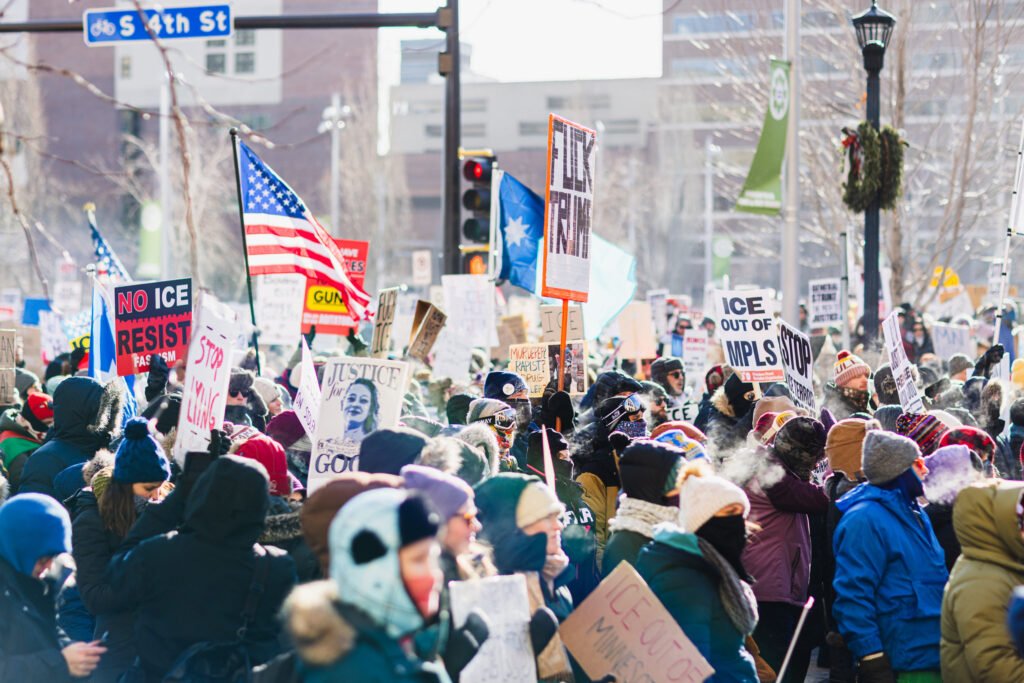
In its conventional use, Antifa refers to a loose umbrella brand that like-minded anti-fascist collectives use to signal a shared movement identity. But over the course of two Trump administrations, it has become a boogeyman for a variety of individuals and organizations who oppose the government’s policies, particularly those protesting against ICE and the wider crackdown on immigration.
During Trump’s second term in office, those public statements have hardened into increasingly aggressive policies. On September 10, 2025, when an influential conservative activist Charlie Kirk was assassinated at Utah University, Trump vented his fury again on Antifa—which has no known connection to the shooting. With an executive order titled “Designating Antifa as a Domestic Terrorist Organization,” he instructed all federal agencies to dismantle the network, triggering a wave of draconian prosecutions across the country.
One fundamental issue, however, has frustrated the administration’s attempts to turn the Antifa label into a formal terrorist designation: under U.S. constitutional law and federal statute, no legal mechanism exists for designating domestic political organizations as terrorist groups.
Shayana Kadidal, a senior managing attorney at the Center for Constitutional Rights who has litigated multiple high-profile cases involving OFAC designations and the material support statute, said those constitutional protections can in fact be circumvented through a “ridiculous” loophole in OFAC’s mandate.
“We have worries they are looking for a way to designate a domestic group as if [they] were foreign terrorists,” he said over the phone from New York City. “And they can do that under this scheme.”
Kadidal was referring to the threat of derivative designations including to its U.S. users. OFAC’s statutory mandate allows it to escalate its designations to entities who materially assist or provide financial or technological support to a previously sanctioned global terrorist group. When applied to digital infrastructure such as A/I, secondary designations could cascade across its entire user base.
“The way this particular sanction scheme works, it’s a two-way prohibition,” Kadidal explained, once the grace period is over. “So you’re not allowed to give help to A/I, but you’re also not allowed to receive assistance from A/I. That becomes a crime as well.”
Derivative designations have been conventionally used as the ultimate threat to cut off targeted entities from their support networks, service providers, and financial intermediaries. But technically, that loophole opens an attack vector in an entirely different direction: it exposes everyone with an email address, account, blog, or website with A/I to the risk of landing on the list of Specially Designated Global Terrorists. For a U.S. citizen, that amounts to a felony with a 20-year prison sentence attached to it.
“I think Autistici has probably foiled that by shutting down their operations and dissolving themselves,” Kadidal said, calling it “a heroic decision” to sacrifice their organization to keep their users safe. On October 14, police seized an A/I server in the Netherlands. Officers stated they were executing a formal U.S. request, copying all the data before sending it to the U.S. According to the group, the encrypted server contains nothing that could cause problems for former A/I users.
For the attorney, however, the main issue is not guessing whether the Trump administration aims at exploiting the loophole, but the systemic problem the whole designation exposes.
“These schemes were all modeled on World War I-era embargoes on [adversaries] like Kaiser Wilhelm’s Germany,” he said. “But the boundaries are not clear anymore.”
Kadidal noted that OFAC’s master registry of designated individuals has grown to “phone directory” size, 12,000 names, as the agency’s reach has expanded throughout the “never-ending” War on Terror. For the veteran attorney—who has for years led the legal representation of captives held in indefinite detention in Guantanamo Bay—that machinery transcends election cycles and passing administrations.
“What’s happened over the last two years is that the Trump people came in and decided, ‘You know what, this is a power that we can use [with] almost no accountability whatsoever, either from the courts or the public, because the public doesn’t really know how it works. So we can use it to go after our political opponents,’” he stressed.
The Digital Iron Curtain
In Spring 2001, the internet still carried the promise of an open horizon. When A/I plugged in its first server, it joined an emerging network of nodes offering a counter-infrastructure to the corporate dominance online. The underlying premise was both practical and utopian: that people across the world could connect directly, free from state surveillance, commercial intermediaries, and the “gatekeepers” of legacy media. Yet, the name chosen for A/I’s very first server carried a quiet prophecy: Paranoia.
Only six months after it went online, the 9/11 attacks shook the world and reshaped the internet, igniting a cat-and-mouse race between surveillance technologies and privacy tools to counter them. This dynamic would define the development of the web—and A/I’s path—in ways no one could foresee when Paranoia first entered the network. With the forced shutdown of A/I, that quarter-century story has come full circle.
The collective was designated under Executive Order 13224, the national emergency decree President George W. Bush signed in September 2001, launching the War on Terror. Those presidential emergency powers have been renewed annually ever since, granting “virtually unfettered authority” to OFAC to sanction alleged terrorist entities down to the present day.
One of the very few provisions curtailing those sweeping powers explicitly concerns personal communications and the free flow of information. Written in 1988 in response to President Ronald Reagan’s aggressive enforcement of Cold War trade embargoes, the Berman Amendment set a red line: no U.S. administration, regardless of national emergency declarations, should become a global censor; the free flow of ideas, news, and political expression should remain strictly outside the scope of statutory sanctions.
With geopolitical tensions escalating once again, the legal safeguards for digital communications still boil down to these Cold War-era checks and balances. This dynamic is the pivotal conflict that the A/I designation brings out into the open. As Washington grows increasingly willing to wield its dominance over global banking and technology sectors to project power abroad, the episode lays bare fractures in the very architecture of the internet.
Only three months before A/I’s designation, the European Commission highlighted these systemic dependencies in its new draft legislation for strengthening the EU’s cloud and AI infrastructure. Without naming the U.S., the Commission warned of the risks that third-country jurisdictions with extraterritorial effects pose to European users, “particularly in scenarios where unilateral decisions by third-country actors could disrupt service provision.” For digital rights experts, these vulnerabilities are no longer hypothetical.
Chloé Berthélémy, a senior policy advisor at European Digital Rights Network (EDRi), assessed that the sanctions faced by A/I make it extremely difficult for a European digital service provider to continue operations. She called its forced shutdown without due process a dangerous precedent and a “hard hit” for digital rights.
“The silence on the side of the EU institutions and the Italian government is deafening,” she said. “That only reveals the real motive of the EU’s current ‘digital sovereignty’ agenda: a purely industrial policy with the sole aim to boost European competitiveness and profits, not European democracy and fundamental rights.”
EDRi, an umbrella organization of over 50 digital rights groups across Europe, has been familiar with A/I’s work for over two decades. Berthélémy described the project as a “safe and secure communications infrastructure” and a critical alternative to Big Tech platforms.
“They were a fundamentally political, democratic initiative by providing part of the critical material infrastructure for antifascist, anti-capitalist and antimilitarist communications in Italy and Europe,“ she said, highlighting that such infrastructure is vital for enabling the freedom of expression in digitized democracies.
While calling A/I’s designation a “worrying overreach by a foreign government,” Berthélémy stressed that it fits into a wider trend where web developers and service providers are under increasing regulatory pressure to compromise user data and safety, including in Europe. The European Commission, she noted, is also exploring ways to impose encryption backdoor obligations and the de facto prohibition of anonymity tools —as well as administrative sanctions for “non-cooperative” service providers.
“There is definitely a threat looming over independent communication infrastructures,” she said. “We see here the risk of either driving reliable operators offering secure services out of the EU market or out of business if they are small or not-for-profit.“
Talking with the A/I-volunteer during the collective’s dissolution process, it was this dual pressure—from hostile U.S. sanctions and disregard at home—that put them in front of an impossible decision. While the collective weighed its legal options and potential risks to its users, “the only sensible thing” to do was to shut down everything once and for all.
“We were born to protect people’s privacy and to allow them to struggle safely, and that we cannot afford compromising,” the former volunteer said. Two days later, all the collective’s servers were shut down.
The Treasury Department’s press office did not respond to Turning Point’s detailed requests for comment by the time of publication. Meanwhile, public records indicate OFAC already moved on from the A/I file, slamming fresh sanctions on the Sinaloa Cartel on September 29 and the International Criminal Court on October 9, the day its former judge was awarded the Nobel Peace Prize.
Benedetta Argentieri
Benedetta Argentieri is an independent journalist and a documentary filmmaker. Amongst her films I Am The Revolution (2018). She works as an editor at Turning Point magazine.

Henri Sulku
Henri Sulku works as an editor at Turning Point. His reporting focuses on political economy, people’s history, and resistance movements.