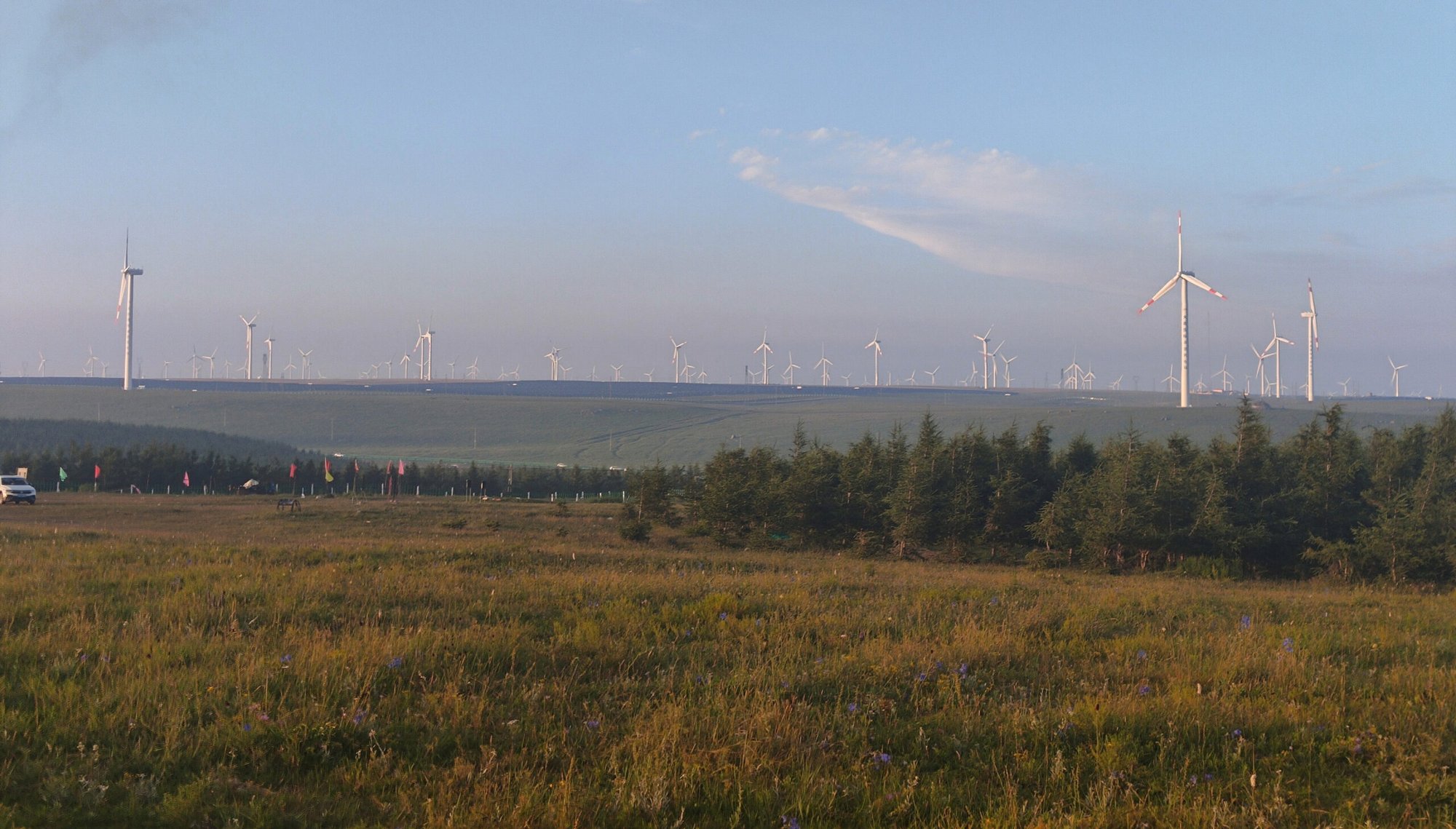



“There is less grass now, and every year it becomes harder to keep enough for the animals.”
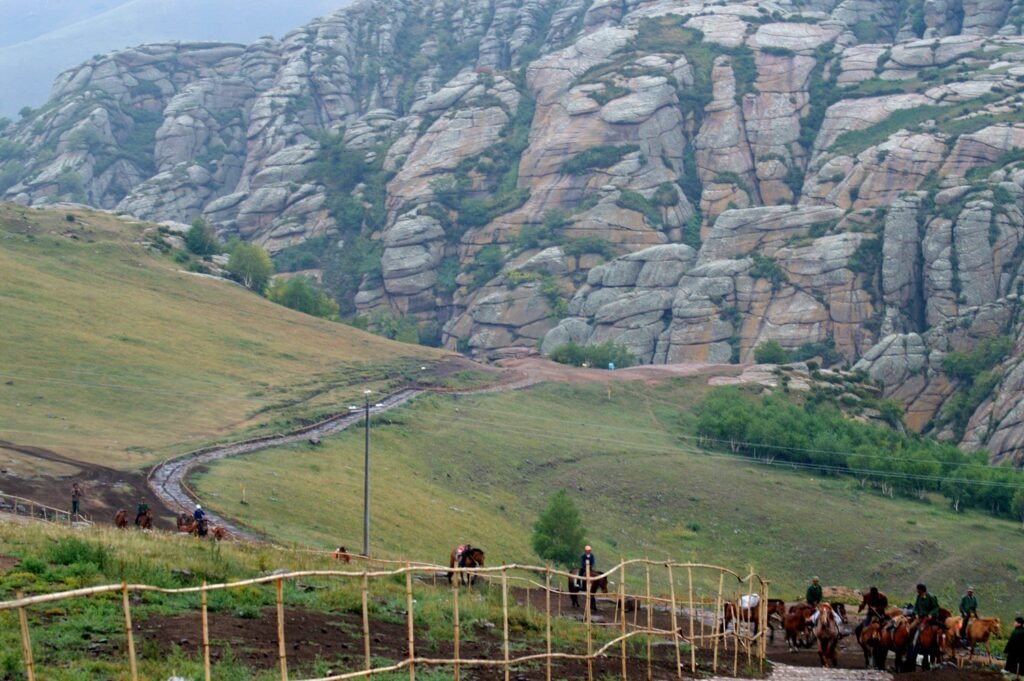
Naran, 47, whose name has been changed to protect his family, has spent most of his life raising livestock in Xilingol, a vast expanse of grassland in Inner Mongolia along China’s northern border with Mongolia. He remembers a different landscape from his childhood, when grass was more abundant and raising animals felt less uncertain. Today, he worries about how much the land will continue to provide.
His observations reflect broader changes across Xilingol. Research examining nearly four decades of grassland change has documented declining vegetation productivity in parts of the region, shaped by both climatic conditions and human activities.
New infrastructure does not arrive on empty land. For generations, Inner Mongolia’s grasslands have sustained pastoral livelihoods like Naran’s. Later came coal and electricity, followed by vast wind and solar projects. Now, the region is being drawn into another transformation: powering China’s rapidly expanding digital economy.
Artificial intelligence may appear almost weightless on a screen, but the infrastructure behind it is anything but. AI depends on buildings filled with servers, electricity to run them, systems to keep them cool, and the land on which all of this stands.
China is increasingly expanding its computing infrastructure in regions where energy and space are more readily available. At the centre of this shift is the East Data, West Computing (东数西算) strategy, a national blueprint designed to better distribute computing resources across the country. Inner Mongolia is one of eight national computing hubs in the network.
In Ulanqab, in the south-central part of the region, the scale of that transformation is already visible. A low-carbon computing base connected to the grid in 2025 was designed to house 25,000 server cabinets, alongside dedicated wind, solar and energy-storage capacity.
For areas that have long supplied resources for China’s development, the AI boom carries a familiar promise in a new form: investment, infrastructure, jobs and economic opportunity. As China’s computing power moves west, a fundamental question remains: how much of the economic value and opportunity it generates will stay in the places that make it possible?

The Energy Equation
Moving computing closer to abundant energy is one thing. Powering it sustainably is another. Data centres run around the clock, consuming electricity to operate servers and keep them cool. According to the International Energy Agency, their electricity consumption worldwide is expected to nearly double by 2030, with AI a major driver of that growth.
That helps explain the appeal of regions such as Inner Mongolia, with their vast wind and solar resources. But proximity to renewables does not automatically make computing green. Coal still supplies a large share of the electricity that data centres consume in China, even as renewable capacity expands.
Electricity is only part of the footprint. Servers produce heat and need cooling, and—depending on the technology and local conditions—that can also increase water consumption. Data centres occupy land and require substations, transmission lines, and other supporting infrastructure. Where computing infrastructure is built therefore matters not only for access to electricity, but for the other resources required to keep it running. The “cloud,” in other words, has a very physical geography.
The search for where to accommodate growing computing demand is already stretching beyond land. Off Shanghai, China has begun operating an undersea data centre that pairs offshore wind with the sea itself as a source of cooling. Farther south, off Hainan, an underwater computing cluster is being used for AI training and other computing-intensive work. These projects are still unusual, but they show how the search for energy, cooling, and space is expanding the geography of computing — from western grasslands and mountains to China’s coastal waters. But wherever that infrastructure goes, it enters places where land, water, and energy already had other uses.
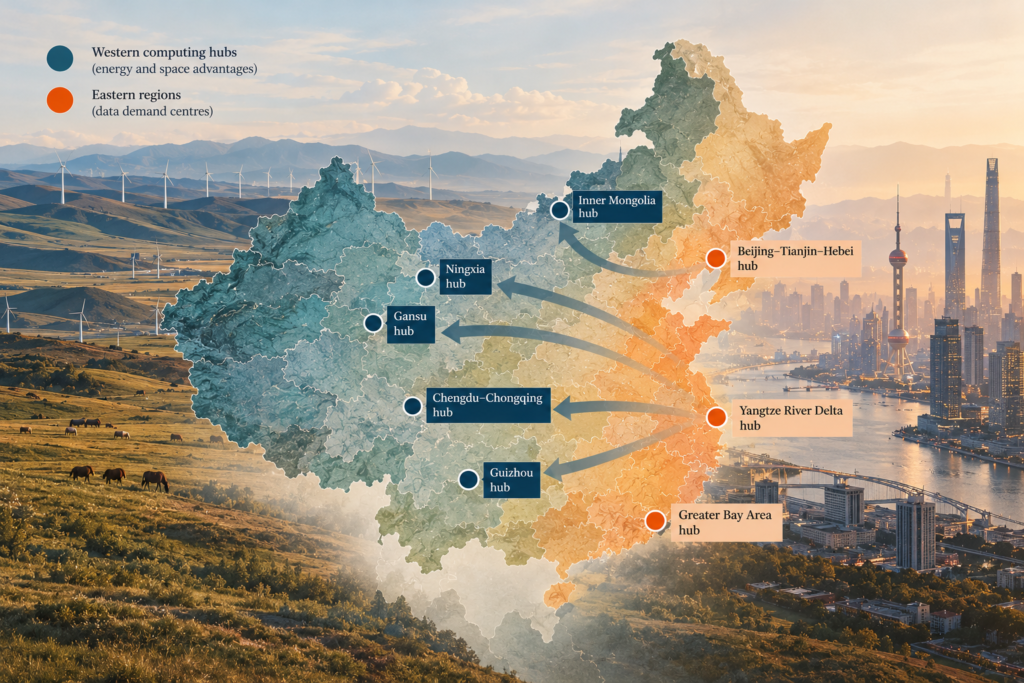
Åshild Kolås knows some of the tensions surrounding those resources from a different perspective. A social anthropologist and research professor at the Peace Research Institute Oslo, she researched pastoralism and environmental change in Xilingol, where decisions over land, water, and other resources have shaped everyday life long before the current data centre expansion.
Today, she sees echoes of those tensions much closer to home. In western Norway, near where she grew up, plans for a large data centre have raised questions for her about electricity consumption, landscape, and what the surrounding communities receive in return.
“It’s going on everywhere in a similar manner,” she said. “It’s not unique to China.”
The political and economic contexts are very different, but the underlying question is similar.
“Who is benefiting and how much as compared to what they’re actually paying for this,” Kolås wondered. Even defining that cost can be difficult. “How much should the beauty of nature be valued at?” she asked. “What is the price?”

Who Benefits from the AI Boom?
More than 2,000 kilometres southwest of Xilingol, mountainous Guizhou offers a different perspective on China’s computing boom.
The province was attracting major data-centre investments already in 2013, nearly a decade before East Data, West Computing launched. Today, it is home to one of the country’s eight national computing hubs. While Inner Mongolia illustrates the environmental demands of expanding computing infrastructure, Guizhou offers a closer look at how such investment can translate into economic opportunities for local communities.
For Lin, a graduate of Guizhou Normal University whose name has been changed to protect her privacy, the province’s digital ambitions became tangible through work. She entered its growing data industry after graduating in 2023. She began in data annotation, the painstaking human labour behind many AI systems: examining information, classifying it, and marking what machines need to learn. She then progressed to more complex projects involving three-dimensional point clouds, video and large models. Looking back, Lin described the job as a “whetstone”—something that had sharpened her skills and confidence. While she was helping machines learn, she was learning too.
Lin’s experience shows one way Guizhou’s digital economy is creating new forms of work. But Kevin Ziyu Liu, an Associate Professor at Guizhou University who studies digital infrastructure and regional development, noted that building data centres and building an economy around them are two separate things.
“If we’re only looking at data centres,” he told Turning Point, “they actually don’t require a lot of people to operate.”
Much of their operation is automated, Liu explained, while the research-and-development divisions of major technology companies tend to stay in cities such as Shenzhen and Shanghai. Beyond the data centres themselves, however, a wider digital economy is taking shape.
Liu has watched local companies emerge to provide digital services for governments, tourism, and traditional industries. Data annotation has also brought digital work to people without advanced technical qualifications. The work can be repetitive—even “boring,” as Liu put it—but it has created opportunities for workers who otherwise might have moved away in search of work. For some workers Liu interviewed, jobs that once required migration to Guangdong or Fujian could now be found closer to home—sometimes for lower salaries but without leaving family and community behind.
Over little more than a decade, data centres have developed alongside high-speed railways, highways, bridges and rapid urban development. For many residents Liu interviewed, these changes are not necessarily experienced as separate transformations. “You think about these as one thing. And that one thing is called development.”
He cautioned against interpreting the attitudes he encountered in Guizhou solely through official narratives, emphasising that residents have experienced substantial changes in mobility, employment, and everyday life.
“It’s not that people don’t criticize because they’ve been fooled,” he said. “People’s lives have been changed so dramatically.”
Lin’s “whetstone” belongs to that larger story. Her experience shows why development cannot be measured by server capacity alone. Yet, China’s computing boom also has deeper historical roots, reflecting the longstanding role of western regions in the country’s economic development.
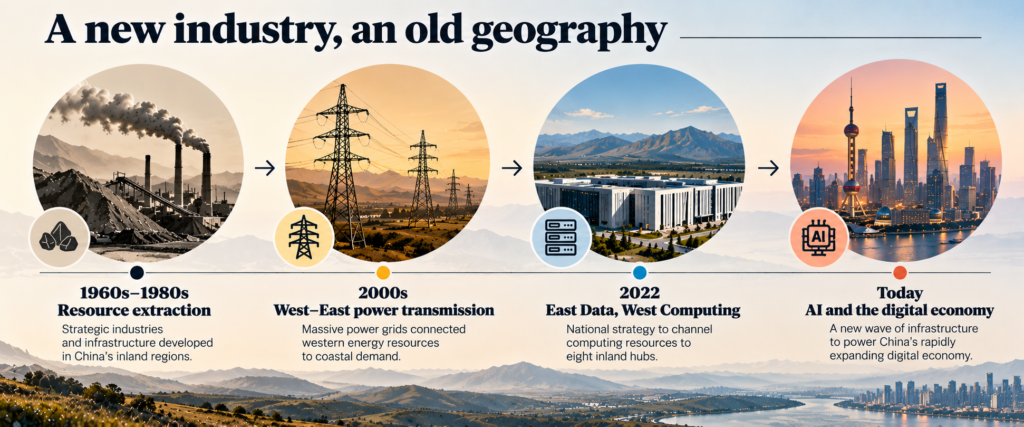
A New Industry, an Old Geography
Liu traces these historical roots back to the Third Front programme (三线建设), which was launched in the 1960s when China relocated strategic industries into its interior. Decades later, West–East Electricity Transmission (西电东送) began delivering western China’s electricity to the industrialising east. Today, computing power is mixed into these flows.
“Western China is again backing up data for the nation,” Liu said.
But that national geography is also a lived one. In Xilingol, it includes pastoral livelihoods like Naran’s, still tied to the land as energy and computing infrastructure expand across the region.
Computing, however, cannot simply be moved anywhere. Some applications still depend on proximity to users, companies, and research centres. Liu points to Inner Mongolia’s proximity to Beijing—a major technology hub in northern China—as an advantage for computing tasks that require fast data transmission, while Guizhou, in the southwest, lies much farther from major technology centres.
Liu also points to efforts to connect computing infrastructure with existing local industries, allowing western regions to develop businesses around the servers instead of simply providing space for them. But what a data centre brings to the place around it can look very different from the scale of the investment itself. That tension extends far beyond China.
In the United States, Corey Young, Director of the Center for Energy and Built Environment at Washington & Jefferson College, raises a similar question about what remains after construction is complete. He compares the arrival of a hyperscale data centre to “a giant American mall” opening in a community—except that relatively few people will work there once construction is complete.
“This is so huge,” he told me, “but it actually doesn’t necessarily employ a lot of people for the long term.”
For Kolås, the issue extends beyond employment to questions about who bear the growing demands of computing and who ultimately controls the technology.
“Everybody wants somebody else to take the burden,” she said, noting that that burden is increasingly tied to a wider geopolitical question. “Who is going to control AI in the future?”
As computing capacity becomes part of that global competition, the race is not only over who controls the technology, but how much infrastructure countries are willing to build to support it. Behind that expansion lies a more fundamental question.
How Much Computing Do We Need?
When I asked Liu what other countries could learn from China’s experiment, he challenged the premise.
“Do we actually need to copy what China is doing to other places?” he asked. “I think that’s the real question.”
Much of the debate around AI infrastructure assumes computing demand will continue to grow, and then centers on how to build enough capacity and secure enough electricity to power it. Liu questions that starting point.
“Not everybody needs the best chips to train AI,” he said.
He points to projects in Yunnan where, he says, older computing equipment has been used for artificial-intelligence applications involving minority languages. “How do you build AI for a community?” he asked.
That possibility sits beside a very different future.
“Do we envision a future of rivalry?” Liu asked. “Do we envision a future where you have a new version of the Cold War?”
China and the United States are investing in computing infrastructure on a scale few countries can match. Liu argues that smaller countries need not follow the same path. Limited resources, he said, can still be used to develop technologies that “support local communities.”
Whether that happens depends partly on what remains in the places hosting the infrastructure. In the United States, Young hopes data centres might provide “an economic development strategy” for rural communities that have been left behind. Yet large facilities can consume substantial resources while supporting relatively few permanent jobs.
Western China offers a more complicated picture. In Guizhou, Lin’s story shows how the digital economy can open new paths for workers beyond the country’s established technology hubs. There is opportunity in that transformation, but no guarantee that its benefits will match its scale. As computing expands, the places providing land, electricity, and infrastructure face a fundamental question: what does development leave locally?
In Xilingol, Naran answers it on a different scale. Livestock remains their main source of income, but it also provides Naran with the means to give his children opportunities beyond pastoral life.
“I want my children to have a choice. If they want to study and build a different life, I want them to be able to do that,” he said. “But to give them that future, I still depend on the animals and on this land.”
China’s westward computing experiment is also a story about what development leaves behind. Its measure may lie not only in how much computing power a place can provide, but in whether that transformation creates more possibilities for the people who call it home.

Gaia Guatri
Gaia Guatri is an independent photojournalist and documentarian specializing in gender inequality, migration, and social justice, with a background in anthropology and international relations. She reports across Europe, China, and Southeast Asia. She collaborates with global media outlets like The Copenhagen Post, Weave News, and Pangyao Magazine to amplify local voices and bring human-centred stories to international audiences.