


The first time I met Yanar Mohammed, we were in a very beautiful apartment overlooking Prospect Park, in Brooklyn, New York. It was a press lunch organized by MADRE, an NGO that supported Mohammed’s work and wanted her to meet as many journalists as possible. It was May 2016, the weather was beautiful, finally warming up after a dreadful New York winter. I walked in, and I saw her in a circle with other women. She was quite short, though she had a unique energy that could captivate the audience.
The day before, Mohammed had spoken at the UN assembly about the situation of women in Iraq: the suffering, the violence, and the perils they were enduring. In some areas, families were hunting down women to protect the tribe’s honor by killing women and hanging their hands on their entrance doors. Women were oppressed and treated as second-class citizens. And with the surge of ISIS, the situation got even worse; women and girls were sold at the market as if they were merely goods.
It was clear she didn’t expect her speech to yield concrete results on the ground, though she was convinced the situation must be as public as possible. It must be on the record, for future generations to remember.
Mohammed was sitting composed at a long oak table. Her back straight, head up. She decided to talk to journalists one-on-one, and I was one of the last in line. As I was waiting for my turn, I observed her. She had brownish curly hair up to her shoulders and very expressive hazel eyes. I remember she was wearing a light blazer, looking elegant and sophisticated. She was using her hands to enforce her words; in her voice, you could hear rage fueled by the injustice women in Iraq—and all over the world—had to endure. As my turn arrived, she squeezed my hand and welcomed me in a very unexpected, warm way.
We hit it off immediately. I asked her many questions about Iraq, after all, the country was one of my areas of focus in the Middle East. Mohammed was quite surprised by my political knowledge of the region, she said she rarely met journalists as interested as I was. She told me how, during the Saddam Hussein regime, she fled to Canada and became an architect. Built a family in Toronto, but she longed to go back home. So, when in 2003 the U.S. started a long war, she hopped on the first flight to Baghdad.
“I had to go back, I wanted to take part in the reconstruction,” she said. “Though it was immediately clear that all the secular forces would be put aside in favor of a Shiite government, which created even more chaos.”
The interview lasted 40 minutes, during which Mohammed told me about the underground shelters for women escaping honor killings. It was a very intricate system throughout the country. The women in the shelters would have the time to recover and then start a new life. In 2003, she founded the Organization of Women’s Freedom in Iraq (OWFI) to have a legal framework for this perilous work.
I was so fascinated by her strength and determination that I told her straight away, “I want to come and visit you.” She smiled and replied, “you are welcome any time.”
We kept in contact. Six months later, I called her to explain the concept behind a new film I was preparing. I wanted to travel to Iraq, Afghanistan, and Syria with an all-women crew to show that women in the Middle East were not merely victims—that there was a movement across borders too often ignored by Western mainstream media. Yanar would be one of three protagonists, alongside Rojda Felat, a Kurdish commander fighting ISIS in Syria, and Selay Ghaffar, a politician and activist in Afghanistan. Three women, three countries, one shared struggle: women’s liberation. She was enthusiastic about the idea.
“We need to organize your trip well. Baghdad is not safe,” she said. In fact, she was increasingly under threat.
Over the years, various governments tried to outlaw OWFI, though no one ever succeeded in doing so indefinitely. Mohammed was not alone anymore; she had built a movement around her. She spread their voice, made alliances. She was dangerous for many. She received several credible threats from Iran-linked militias, from radical Sunni groups, and sometimes from the regime itself.
It took several months of planning—coordinating logistics, security protocols, and contacts on the ground—before Mohammed finally gave us the green light. In late February 2017, with filmmakers Andrea Di Cenzo and Francesca Tosarelli, we landed in Baghdad.
I fell in love with the city straight away. It was my first visit, and I was very eager to discover the cradle of civilization. Baghdad, a city full of contradictions, is charming around the Tigris bank and split in the middle by the tall walls of the Green Zone—a city within the city, forbidden to any civilian. As in most Middle Eastern cities, the traffic was heavy. You could queue for hours, always with the fear of a car bomb exploding randomly during rush hour.
We first visited OWFI’s office, located in a civilian neighborhood not far from the river banks. The white iron gate opened to a garden with trees and flowers. Mohammed greeted us and set up a program for the shooting. She introduced us to the dozens of women who were working in the office with smiles and care. She was very happy that we had finally come to observe and report on the ground their work.
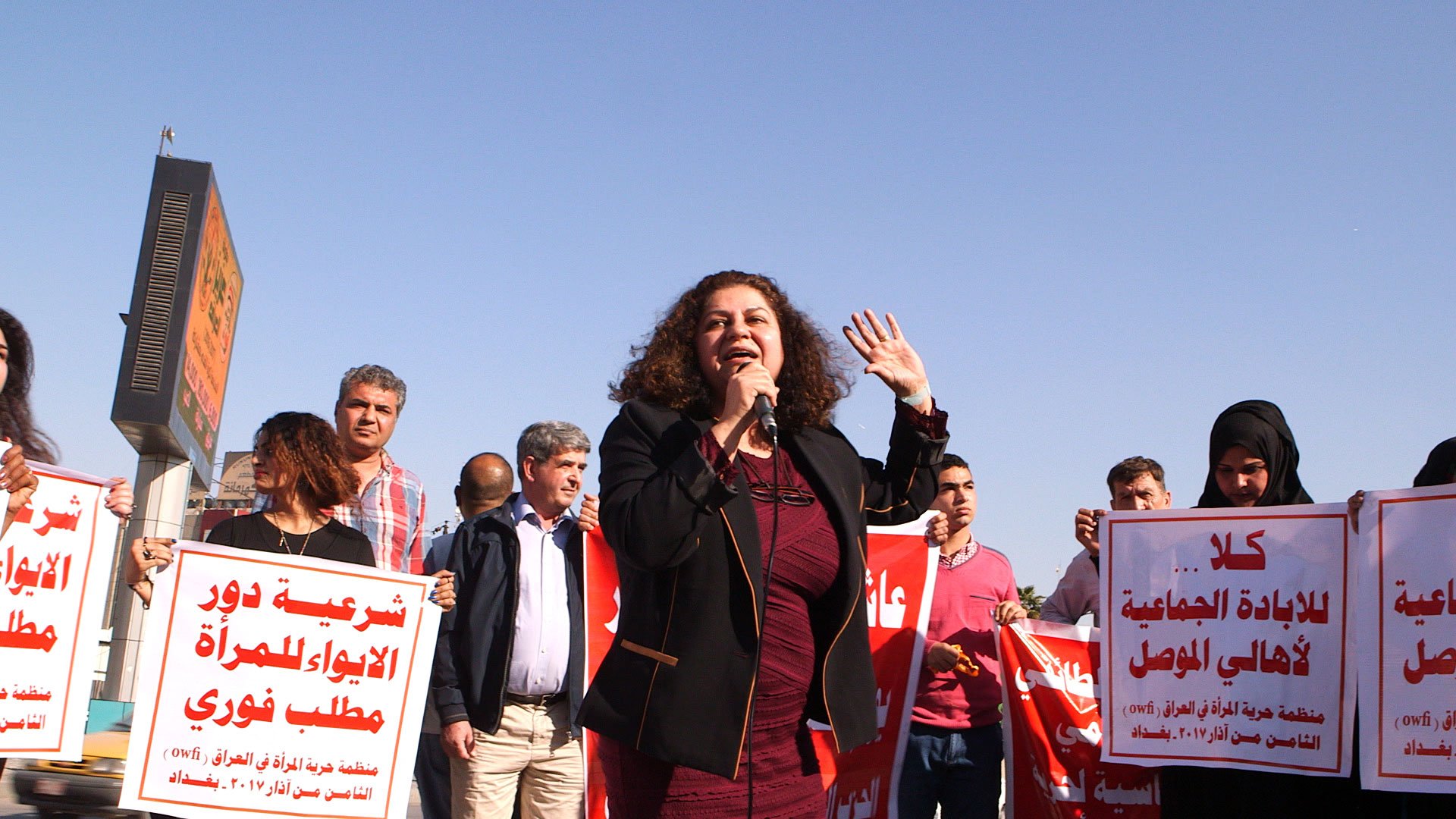
The filming was intense. The group decided, for the first time, to celebrate March 8 on the streets. We arrived by bus, got to the middle of the square, and set up a mic. One by one, women started to shout slogans against violence, oppression, and for the revolution. When Mohammed’s turn arrived, she gave courage and hope.
In the meantime, people in the passing cars were looking at us as if we were from another planet. Some stared with hatred, others just surprised. Eighteen minutes later, the police arrived and dispersed us.
“This was much longer than other times,” said one of the women with us. On the journey back on the bus, everyone was singing and happy with how it went.
Mohammed’s strength also relied on allies within Communist groups in Iraq. She was critical of their approach to women’s struggle. “They always tried to delay it. But which revolution will they do, which is harder than the revolution of women?”
She was very insistent on also educating the men. “We have allies that come with us to demonstrations or sit-ins. But then we look at how they behave at home. Who is doing the dishes? Sometimes men are very good with words, but lack in action”.
We had the opportunity to go to one of the shelters where women lived with their children. We arrived at sunset, disguised with veils. Our equipment was also camouflaged. The two-floor apartment hosted four women, each with a history of violence and rebirth.
“I want to be a lawyer,” said a woman who never wanted to be shown on camera. “I want to help other women like me”.
At the time, OWFI had over 20 shelters and was able to save as many as 500 women. They were in the process of opening a sanctuary for LGBTQI people too. The first one ever in the country.
“When women stay in our shelters, in the beginning we take care of them, but eventually it’s about empowerment and political awareness, and we try to help them to become human rights activists and leaders in their community,” said Mohammed. Emancipating women, educating them, and building a movement were the keys to her success. She wanted other women to continue her work in case something happened to her.
We stayed in contact for many years; she was updating me about her work and how the film helped to spread their work beyond the Middle East. The last time I talked to her was about two years ago when we participated in a panel together. I know she took part in the endless demonstrations in Tahrir Square, I know she was very outspoken against Shiite militias and the corruption of the government. Fear for her life increased as did the threats against her.
Yet, she didn’t budge; nothing could stop her work. Mohammed was resolute to stay in Baghdad as much as possible, while going back to Canada once in a while. We agreed to speak soon, but we never did.
On March 2, as soon as the bombs began dropping on Baghdad, and another war started in the region, her enemies saw an opportunity. According to OWFI, at 9 am local time, two masked men on a motorbike waited for her in front of her home. As soon as she stepped out, they opened fire, leaving her bleeding on the pavement. In the hospital, doctors tried to save her, but it was too late. She was 65 years old, most of her life spent helping other women. Her killers chose their moment deliberately — betting that war would swallow the news, that chaos would protect them, that nobody would bother. They were wrong. The forces that sought to silence her — militias, occupation, patriarchy — are still at work. Her death is not incidental to this moment in history. It is part of it.
The world has lost one of the most prominent feminist figures at a time we needed her more than ever — a true revolutionary, a freedom fighter who understood that liberation is built slowly, shelter by shelter, woman by woman. She leaves behind a great legacy: the hundreds of women she trained, mentored, and inspired, will carry her work forward. So will the countless women around the world who watched her story and decided to act. You can kill a woman, but you cannot kill the revolution of women.
Our hearts go out to her family, her comrades, and everyone at OWFI who fought alongside her.
Rest in power, Yanar. We will continue your work.
Benedetta Argentieri
Benedetta Argentieri is an independent journalist and a documentary filmmaker. Amongst her films I Am The Revolution (2018). She works as an editor at Turning Point magazine.